

Bullying Prevention in Middle School: A Principal's Guide to the Programs That Work — and the Ones That Don't
- John Nguyen
- 2 days ago
- 14 min read
Why bullying peaks in middle school, why most prevention programs underperform, and what the evidence actually supports for grades 6–8
The Issue: A Problem That Most Schools Address Badly
If you are a middle school principal, you are leading inside the grade band where bullying — in all its forms — is most concentrated, most damaging, and least successfully addressed by the standard prevention practices available.
The numbers are consistent across data sources. According to research published in PMC, national survey data indicates that 22.2% of students aged 12–18 report being a target of bullying — and bullying peaks in middle school, with the highest rates reported by sixth grade students (29.5%). Research developing the BullyDown text-messaging prevention program reports that an estimated 20–24% of middle school students bully their peers "regularly" or more often each semester.
The mental health consequences of middle school bullying are well-documented and severe. The same PMC research notes that bullying victimization is associated with poor general health, anxiety and post-traumatic stress, depressive symptoms, non-suicidal self-injury, suicidal ideation, and suicide attempts — and that evidence suggests a causal relationship between bullying victimization and anxiety and depression. The harm extends beyond direct victims: research on bystanders has consistently found that students who witness bullying report elevated internalizing symptoms even when they are not directly involved.
This is the bullying landscape middle school principals are leading inside. And the unfortunate reality is that most schools — including most schools that have adopted formal anti-bullying programs — are not seeing meaningful reductions in bullying rates, school climate measures, or student wellbeing outcomes.
This article addresses the question directly: given a well-developed evidence base on what works in bullying prevention, why do most middle school anti-bullying efforts underperform, and what does the research actually support for grades 6–8?
This piece complements our earlier guidance on cyberbullying specifically, which addressed the digital subset of the broader bullying problem. The current article addresses bullying as a whole — in-person, relational, verbal, and digital — and the school-level leadership work required to reduce it.
Why Middle School Sits at the Bullying Peak
Bullying does not concentrate in middle school by accident. The developmental and structural reasons are well-understood, and they have direct implications for what prevention should look like.
The developmental window. Early adolescence is the developmental moment when peer hierarchy, social comparison, and group identity become the dominant features of student psychology. The same developmental processes that make middle schoolers extraordinarily attuned to belonging also make them extraordinarily vulnerable to its denial. Bullying, in this developmental frame, is not primarily about cruelty for its own sake. It is about establishing, contesting, and maintaining social position — which in early adolescence is felt to be existential.
The structural transition. Students moving from elementary to middle school encounter a fundamentally different social environment. Larger student bodies, multiple teachers, departmentalized scheduling, less adult oversight in unstructured spaces, and substantially more autonomy combine to create more opportunities for bullying — both in physical spaces (hallways, cafeterias, locker rooms, bathrooms, buses) and in social structures (cliques, peer groups, online networks that map onto offline relationships).
The reduced visibility to adults. Elementary teachers typically see their students for the entire school day and can intervene in social dynamics in real time. Middle school teachers see each student for one or two periods, often have 100+ students across their day, and have limited visibility into the social patterns operating across the building. The adult-eye coverage of student social life drops sharply at the middle school transition.
The intersection with technology. Even setting aside cyberbullying specifically, middle schoolers' phone and social media use means that in-person bullying often has a digital amplifier. A confrontation in the hallway can be recorded and shared within minutes. A social exclusion can be documented and rebroadcast through group chats. The in-person bullying landscape and the digital bullying landscape are increasingly the same landscape.
The under-reporting problem. Most middle school bullying is not reported to adults. Students fear retaliation, do not trust that adults will respond effectively, and are developmentally predisposed to manage social problems within the peer group rather than escalating them to authority figures. Schools that rely on student reporting as the primary signal of where bullying is happening will systematically misunderstand their own bullying landscape.
This is the structural reality bullying prevention has to operate inside. Programs that ignore these conditions — or that assume they can be addressed through poster campaigns, single assemblies, or feel-good messaging — produce predictable, disappointing results.
What the Evidence Actually Says About Bullying Prevention
The research base on school bullying prevention is now substantial. It tells a more nuanced — and more demanding — story than most school-adopted programs reflect.
The headline finding: well-implemented programs work. The 2021 Campbell Collaboration systematic review and meta-analysis, the most authoritative quantitative review of the field, found that school-based bullying prevention programs are effective at reducing both bullying perpetration and victimization. The U.S. Community Preventive Services Task Force similarly recommends school-based anti-bullying interventions on the basis of strong systematic review evidence: students in schools with these programs report fewer episodes of bullying perpetration, fewer episodes of bullying victimization, and fewer mental health symptoms such as anxiety and depression.
The qualifier: most programs in actual use are not well-implemented. The same research base that supports bullying prevention in principle is unambiguous that the gap between "program adopted" and "program implemented at the dosage and fidelity the evidence supports" is enormous. The most common implementation failures include: training a small number of staff while leaving the rest of the building uninvolved, running the program for one year and discontinuing it, focusing on one or two visible components (an assembly, a poster) while ignoring the structural work, and using a program developed for one age group with students at a substantially different developmental stage.
The age-decline pattern. Research by Yeager and colleagues, a three-level meta-analysis cited in the Psychiatric Services evidence-base review, found that anti-bullying program efficacy declines among older adolescents. Programs that produce strong effects in elementary settings produce more modest effects in middle school and weaker effects in high school. This finding has direct implications for middle school principals: programs adapted from elementary research may underperform unless they have been specifically designed and tested for the middle school developmental window.
The components that drive effectiveness. The Psychiatric Services evidence-base review of antibullying interventions identified two high-evidence programs (KiVa and Friendly Schools Friendly Families) and analyzed what their effective components have in common. Across both programs, the same architecture appears:
School-level components that build positive school climate and increase bullying awareness.
Classroom-level components that build positive classroom culture.
Student-level components that develop emotional-cognitive processes, communication, and problem-solving skills.
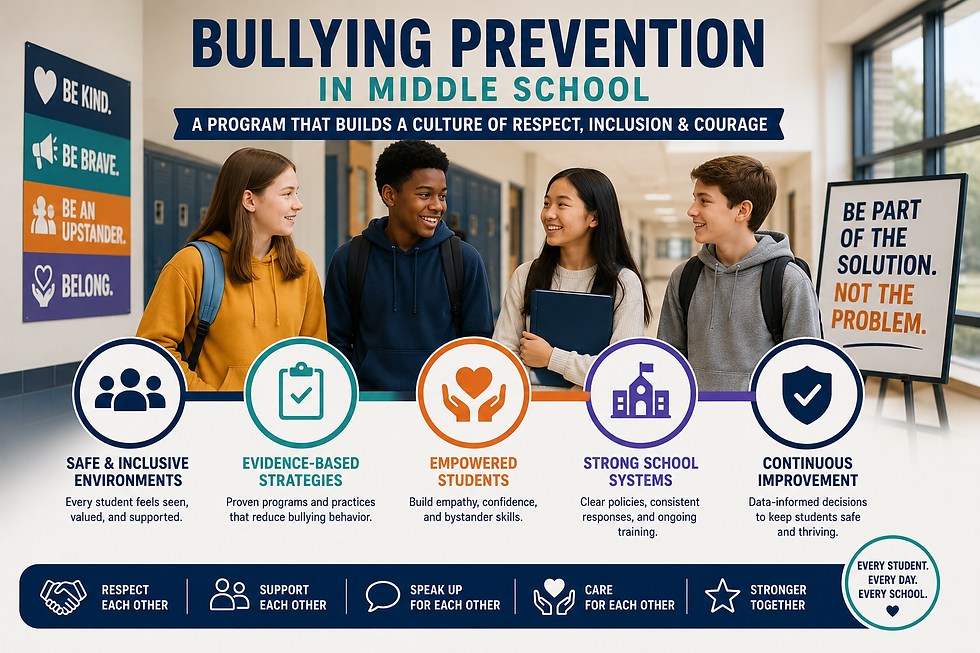
This three-level structure — school, classroom, student — is the architecture that distinguishes effective bullying prevention from the symbolic anti-bullying gestures most schools default to.
The bystander finding. Multiple programs in the evidence-supported set place heavy emphasis on the role of bystanders. KiVa specifically targets bystander behavior as a core mechanism. The research finding is consistent: in most bullying incidents, the bullying behavior is sustained or escalated by the response of peer witnesses. Programs that successfully shift bystander norms — making it socially expected that students intervene, redirect, or seek help — produce stronger effects than programs that focus only on victims and perpetrators.
The school climate finding. Research on bullying and school belonging consistently identifies students' sense of school belonging and perception of school climate as core mediators of bullying outcomes. Schools where students feel they belong have less bullying and less of the internalizing symptoms that bullying produces. The work of building a strong school climate is not separate from the work of bullying prevention; it is one of its primary mechanisms.
The Programs Worth Considering — and the Decision Framework
If a middle school principal is going to adopt a formal bullying prevention program, the evidence-supported options are relatively few. They include:
Olweus Bullying Prevention Program (OBPP). The most-researched school-based bullying prevention program globally. Per the program's official source, OBPP is a comprehensive approach that includes schoolwide, classroom, individual, and community components, designed for long-term change to create a safe and positive school climate. The program has been implemented in thousands of U.S. schools and shown to reduce bullying, improve classroom climate, and reduce related antisocial behaviors. Cost varies by school size; published examples include approximately $3,000 for a school of 500 students, 30 teachers, and 12 committee members, with most materials being one-time purchases.
KiVa. A Finnish-origin program that has been particularly studied for its bystander-focused architecture. Strong evidence base across multiple countries, with the Psychiatric Services review classifying it as high-evidence.
Friendly Schools Friendly Families (FSFF). An Australian-origin program that includes family-focused activities alongside school and classroom components. Also classified as high-evidence.
PBIS-based bullying prevention (BP-PBIS) and Expect Respect. Positive Behavioral Interventions and Supports adaptations specifically focused on bullying. The Colorado Department of Education's evidence-based bullying programs guide notes that BP-PBIS and the middle and high school version (Expect Respect) have produced promising outcomes, including lower levels of bullying and positive staff ratings of effectiveness.
Second Step social-emotional learning (SS-SEL). The middle school version of the Second Step SEL program includes units on bullying prevention. The evidence base is stronger for the SEL framework broadly than for the bullying-specific units alone, but the integrated approach has merit.
The decision framework. For most middle school principals, the operative question is not "which program is best in the abstract?" but "which program is implementable at fidelity in our specific school, sustained over multiple years, with the resources we actually have?" A medium-evidence program implemented well will outperform a high-evidence program implemented poorly every time.
Practical decision factors:
Existing infrastructure. Schools already running MTSS or PBIS frameworks may find PBIS-based bullying prevention easier to implement than starting a separate program.
Staff capacity. Programs that require substantial staff training (OBPP, KiVa, FSFF) will not work in schools that cannot commit to multi-year professional development.
Cost and resource alignment. The cheapest programs are rarely the most effective; the most expensive are not always within reach. Match resource commitment to expected fidelity.
Community fit. Programs developed in different cultural and national contexts (KiVa from Finland, FSFF from Australia) translate but require local adaptation.
Multi-year commitment. No bullying prevention program produces meaningful effects in year one. If your school cannot commit to three to five years of sustained implementation, the program will not produce the outcomes the research describes.
The Structural Layer Most Anti-Bullying Programs Don't Address
Beyond program selection, there is a structural reality that the most rigorous bullying research increasingly emphasizes: bullying prevention has to address the daily conditions of the school that produce bullying opportunities, not only the response to incidents that have already occurred.
The conditions that drive bullying volume in middle school include:
Unstructured time and weak adult presence. Hallway transitions, cafeterias, locker rooms, bathrooms, before-school and after-school spaces — these are where most in-person bullying happens. Schools with strong adult presence and clear norms in these spaces report substantially lower incident rates than schools without them.
Inconsistent classroom management. When some classrooms in a building have strong management and others do not, the schoolwide bullying rate climbs. Bullying behaviors that would be quickly addressed in a well-managed classroom escalate in classrooms without consistent norms.
Phone-driven amplification. Even setting aside cyberbullying as its own category, the smartphone has changed the dynamics of in-person bullying in middle school. A confrontation that would have ended at the hallway in 2010 can now be recorded, shared, and recirculated within minutes — turning a single moment into a sustained reputational event. The structural removal of phones during the school day reduces both the production of digital harassment content and the amplification of in-person incidents. Schools that have implemented decentralized phone-free systems — for example, the Safe Pouch system from Win Elements, in which every teacher and administrator has unlocking authority — find that the bullying landscape changes meaningfully. The volume of incidents the discipline system has to absorb declines, which in turn allows bullying prevention programs to operate at the dosage the research supports rather than being overwhelmed by reactive incident management.
Weak family-school communication. Schools where families do not learn about bullying incidents until they are well underway often find that incidents have escalated past the point where school intervention can fully resolve them. Strong, proactive family communication — about both prevention and specific incidents — is part of the structural prevention work.
For additional research on how structural school decisions — including phone policy, school climate, and decentralized enforcement — connect to bullying, harassment, and overall school safety, see the Win Elements research library.
The Practice: A Middle School Principal's Playbook for Real Bullying Prevention
If you are a middle school principal trying to lead bullying prevention that actually reduces bullying — rather than producing a binder, a poster, and a check on the district's compliance list — here is a sequence drawn from the strongest current evidence.
Step 1: Get an honest baseline
Before adopting any program, document what bullying actually looks like in your school. Sources of information:
An anonymous student survey — the Olweus Bullying Questionnaire is the field standard, but other validated instruments exist. The point is to measure prevalence, location, and patterns systematically rather than relying on referrals.
Staff observation data about where and when incidents happen.
Student focus groups that surface the social dynamics adults often miss.
A review of discipline data for patterns of incidents that may not have been categorized as bullying but reflect it.
The baseline serves two purposes. First, it tells you where to focus prevention work. Second, it gives you a measurable starting point against which to evaluate program implementation over time.
Step 2: Choose a program your school can actually implement
Given the implementation-fidelity gap that drives most anti-bullying program failures, the decision-making logic should be implementation-first.
A serious adoption decision asks:
Can our school commit to three to five years of sustained implementation?
Do we have a designated coordinator with adequate time and authority?
Can we train every staff member — not just a subset?
Do we have buy-in from district leadership for the resource commitment?
Does the program fit the developmental stage of our students?
Does it integrate with existing frameworks (MTSS, PBIS, SEL)?
If the answer to most of these questions is no, your school is not ready to adopt a formal program. The honest move is to first build the structural conditions that would allow successful implementation — and to address bullying through climate-level work in the meantime.
Step 3: Build the three-level architecture even without a packaged program
The components that drive effectiveness across the evidence-supported programs are not unique to those programs. The three-level architecture — school, classroom, student — can be built deliberately even by schools that have not adopted a formal package.
School level:
A clear, public schoolwide stance on bullying as unacceptable.
Visible adult presence and engagement in unstructured spaces.
Consistent response protocols when incidents occur.
A real anonymous reporting channel that students actually trust.
Schoolwide language and norms around belonging and inclusion.
Classroom level:
Every classroom operates from consistent norms about how students treat each other.
Teachers are trained to recognize relational and verbal bullying, not just physical incidents.
Classroom community-building is part of routine instruction, not an add-on.
Bystander expectations are explicit and reinforced.
Student level:
Social-emotional learning that builds the skills students need to navigate conflict without escalating it.
Specific instruction in bystander behavior — what to do when you witness bullying.
Pathways for students to report safely.
Targeted support for students who are repeatedly victimized or who repeatedly bully.
Step 4: Engage bystanders as the central mechanism
The bystander finding is one of the most consistent in the bullying research literature. Most bullying incidents involve peer witnesses, and those witnesses' responses substantially shape whether the incident escalates, sustains, or ends.
Effective bystander engagement includes:
Teaching students what bullying actually looks like — including the relational and verbal forms that are often missed.
Giving students concrete language and scripts for responding to bullying they witness.
Creating low-risk reporting pathways so bystanders can act without becoming targets themselves.
Recognizing and reinforcing bystander intervention when it happens.
Building school norms in which it is socially expected, not socially costly, to stand up to bullying.
The shift in bystander behavior is what distinguishes high-effect programs from low-effect ones. It is also the work most middle schools underinvest in.
Step 5: Address the structural drivers
Bullying prevention works best in schools where the structural conditions reduce bullying volume in the first place.
Concrete moves:
Strong adult presence in hallways, cafeterias, and other unstructured spaces.
Consistent classroom management across the building.
A genuinely enforced phone-free school day that reduces digital amplification of in-person incidents and limits recording in spaces where students experience vulnerability.
Clear, predictable schedules that minimize chaotic transitions.
Strong family communication that builds trust before incidents occur.
The principal who reduces the daily inputs to the bullying system is doing prevention work — even when that work does not look like a formal anti-bullying program.
Step 6: Train every adult — including the substitutes, the paraprofessionals, and the cafeteria staff
Anti-bullying programs fail most often when prevention remains the property of a small group of trained staff while the rest of the school continues to operate from inconsistent assumptions.
Real implementation includes:
Initial training for every adult in the building about what bullying looks like, how to respond, and what the school's reporting protocols are.
Annual refreshers, particularly when new patterns emerge (cyberbullying forms shift; new platforms introduce new dynamics).
Clear expectations that every adult intervenes when they witness bullying — and that intervention is supported by school leadership.
Step 7: Engage families substantively
Families are essential partners in bullying prevention, but the work has to be substantive — not just informational.
Effective family engagement on bullying includes:
Education on what bullying looks like at the middle school stage — including relational and digital forms that families often do not recognize.
Clear guidance on what to do when their child is victimized, witnessing, or perpetrating.
Real participation in restorative or accountability processes when their child is involved in an incident.
A trusted communication channel for families to raise concerns about social dynamics affecting their child.
Step 8: Sustain the work for years
The single most important predictor of whether a school's bullying prevention work produces measurable outcomes is whether the work is sustained over multiple years. Bullying prevention is not a one-year initiative.
Sustained implementation includes:
Year-over-year continuity in the program, the coordinator, and the schoolwide focus.
Annual review of baseline data to track whether prevention is working.
Refinement based on what the data shows, not abandonment of the framework when results are slower than hoped.
Protection of the work from competing initiatives that would dilute attention.
Schools that commit to a three-to-five-year arc and protect it produce the outcomes the research describes. Schools that change programs every two years see no cumulative effect.
What the Research Still Doesn't Tell Us
Honest leadership requires acknowledging the limits of current evidence.
Which specific program is best for any specific school? The meta-analytic research supports a class of well-designed programs, but does not provide head-to-head evidence ranking them. Local fit matters as much as comparative efficacy.
How much of bullying is preventable through school-level work alone? Some of the strongest drivers of bullying — broader social media culture, family stressors, neighborhood-level dynamics — are partially outside school authority. Schools can substantially reduce bullying but cannot eliminate it.
How will evolving technology change the bullying landscape? AI-generated content, deepfake images, and emerging social platforms continue to produce new bullying dynamics faster than research can evaluate them. Schools should expect to adapt prevention practices as the landscape continues to evolve.
The Bottom Line for Middle School Principals
Bullying peaks in middle school. It causes substantial harm to victims, bystanders, and the broader school climate. And the standard anti-bullying practices most schools default to — assemblies, posters, awareness campaigns — produce little measurable benefit.
The evidence base on what does work is real but demanding. It requires multi-year implementation, whole-school adoption, the three-level school-classroom-student architecture, deliberate bystander engagement, structural reduction of incident-producing conditions, and sustained leadership commitment that outlasts any single school year.
The students at your school will form their understanding of how social cruelty is responded to — and how it is not — during their three years in grades 6–8. The patterns established in these years carry forward into how they treat peers, intervene as bystanders, and understand the social contract of institutions. Bullying prevention is not a peripheral school initiative. It is one of the core formative experiences your school provides.
The structural moves — choosing the right program, building the three-level architecture, engaging bystanders, addressing the structural drivers, training every adult, partnering with families, sustaining the work — are within your authority. The research supports them. The students need them.
Lead the implementation. The outcomes follow.
Sources Cited
Gaffney H, Ttofi MM, Farrington DP. "Effectiveness of school-based programs to reduce bullying perpetration and victimization: An updated systematic review and meta-analysis." Campbell Systematic Reviews, 2021.
Patel NA, et al. "Antibullying Interventions in Schools: Assessing the Evidence Base." Psychiatric Services, 2024.
Yeager DS, Fong CJ, Lee HY, et al. "Declines in efficacy of anti-bullying programs among older adolescents: theory and a three-level meta-analysis." Journal of Applied Developmental Psychology, 2015. Referenced in Patel et al.


Comments