

Cyberbullying in Middle School: A Principal's Guide to Real Prevention in the Social Media Era
- John Nguyen
- 2 days ago
- 12 min read
Why most cyberbullying policies fail — and what structural prevention actually requires in 2026
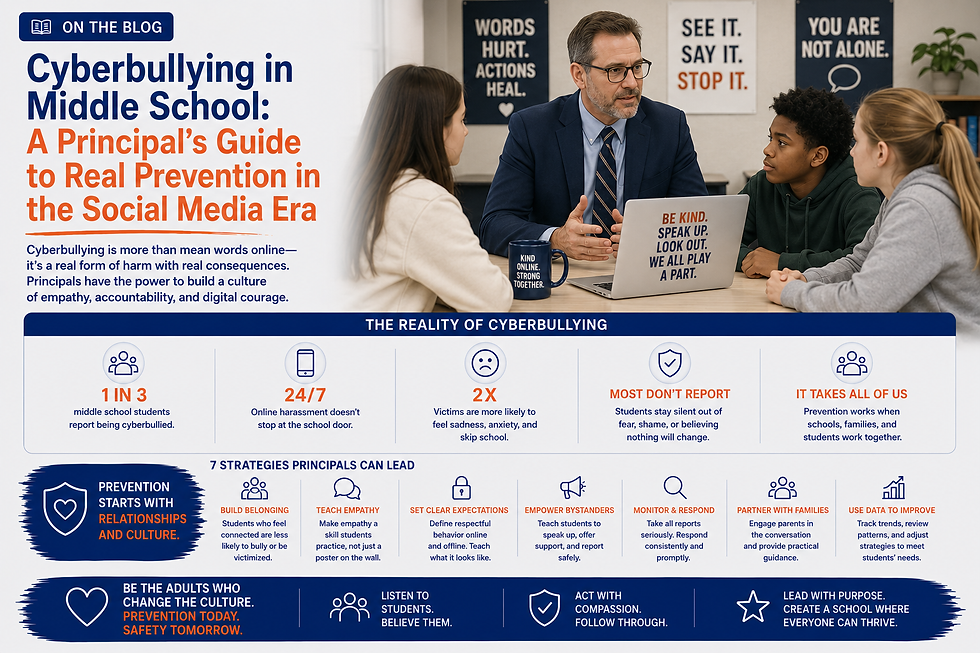
The Issue: A Problem That Peaks in Middle School
If you are a middle school principal, you are leading inside the grade level where cyberbullying is most concentrated, most damaging, and most difficult to address.
According to PACER's National Bullying Prevention Center, the percentage of schools that report cyberbullying occurrences at least once a week is highest among middle schools (37%), followed by high schools (25%), and far behind that, elementary schools (6%). Middle school is not just one stage along the bullying continuum. It is the peak.
The numbers underneath that figure are sobering. Research published in 2025 in the Journal of Medical Internet Research — a longitudinal study of cyberbullying among middle school students before and during COVID — confirms that cyberbullying prevalence has risen substantially over the past decade. A systematic review cited in that study found that cyberbullying victimization rates ranged from 6% to 46.3% in 2015 and rose to 13.99% to 57.55% by 2019, with continued increases since.
The most recent national figures from the U.S. Department of Education's School Crime Supplement, summarized at StopBullying.gov, show that among students ages 12–18 in grades 6–12 who reported being bullied at school in 2022, about 21.6% reported being bullied online or by text — including nearly twice as many girls (27.7%) as boys (14.1%). The 2023 Youth Risk Behavior Surveillance System data from the CDC found that approximately 16% of high school students were electronically bullied in the 12 months before the survey. The middle school numbers are consistently higher.
Bullying in general, and cyberbullying specifically, is more common in middle school than in high school. According to a synthesis of recent surveys, bullying affects 38.4% of middle schoolers compared with 29.7% of high schoolers. And the mental health consequences are well-documented. A 2025 Lancet Regional Health – Americas prospective cohort study of middle schoolers found significant associations between cyberbullying exposure and poor mental health outcomes, including increased substance use experimentation.
The picture is consistent across data sources: middle school is where cyberbullying lives, and where the most consequential prevention work has to be done.
Why Middle School Is the Cyberbullying Inflection Point
Cyberbullying in middle school is not a coincidence of timing. It is a developmental phenomenon, and understanding why matters for any principal trying to address it.
Middle schoolers are at the developmental window when peer comparison, social hierarchy, and identity formation become the dominant features of their psychology. Add a smartphone with constant social media access and the result is predictable: any normal adolescent social dynamic — a falling out, a misunderstood comment, a romantic rejection, a perceived slight — can now be amplified, recorded, screenshotted, shared, and archived in front of an audience of hundreds within minutes.
The mechanisms are well-documented:
The audience problem. Traditional schoolyard bullying happens in front of a small group of bystanders, most of whom are physically present and aware that they may someday be the target. Cyberbullying happens in front of an audience that is potentially limitless, asynchronous, and emotionally detached. The reputational stakes for the victim are dramatically higher.
The escape problem. A student bullied at school used to be able to go home and get a break. The smartphone has eliminated that buffer. Research from the Digital Wellness Lab and others has documented that cyberbullying follows students 24 hours a day, with consequences for sleep, anxiety, and depression that often dwarf the original incident.
The evidence problem. Cyberbullying generates persistent digital evidence — screenshots, group chat logs, recorded videos — that can be redistributed indefinitely. A single humiliating moment can resurface months or years later.
The bystander problem. Research published in 2021 in PMC found that middle school students who witness cyberbullying report significantly higher levels of depression, anxiety, and somatic symptoms than non-bystanders — even when the witness is not directly involved. The harm is not contained to the victim and the perpetrator. It radiates through the entire peer network.
The reporting problem. Most students who are cyberbullied do not tell an adult. According to the South Denver Therapy 2025 synthesis of bullying statistics, fewer than half of bullied students notify school staff. The reasons range from fear of retaliation to belief that adults cannot help to the simple developmental reality that early adolescents are predisposed to manage social problems internally rather than turn to authority.
This is the environment middle school principals are leading inside of. And it is the reason traditional bullying policies — the kind that depend on victims reporting incidents to administrators who then investigate and impose consequences — fail at scale.
The Evidence: Why Most Cyberbullying Policies Underperform
Federal guidance on bullying prevention has converged on a clear, evidence-supported framework. The SchoolSafety.gov bullying and cyberbullying resource page, maintained by an interagency federal effort, identifies five core strategies:
Create a safe and positive school climate.
Implement social and emotional learning to help students build skills, manage emotions, and establish positive relationships.
Set and enforce policies that outline behavioral expectations and monitor places where bullying is more likely to occur.
Conduct teacher and staff training and promote classroom-based bullying prevention activities.
Engage families and students to promote communication and reinforce prevention strategies.
These are the right principles. The challenge is that they are widely adopted in name and inconsistently implemented in practice.
The Colorado Department of Education's 2025 Bullying Prevention Model Policy, one of the most comprehensive state-level bullying frameworks, explicitly recommends aligning bullying prevention under a Multi-Tiered System of Supports (MTSS) framework — the same evidence-based structure used for academic and mental health interventions. Tier 1 universal supports for all students. Tier 2 targeted supports for some students. Tier 3 intensive supports for the few students who need them.
The Colorado guidance also makes a critical distinction that many middle school principals miss: per the CDC, cyberbullying is "a location where bullying occurs and not a type of bullying itself." Students may use technology to verbally or relationally bully others, and this can occur during instructional time, between classes, or outside of school entirely. The lines between in-person bullying and cyberbullying are increasingly blurred — a fight that starts in a hallway may be recorded and posted online within minutes, becoming both at once.
StopBullying.gov's federal resource on cyberbullying laws and policies confirms that all 50 states have bullying prevention laws, most of which now include electronic forms of harassment. But the specific requirements vary widely, and most state laws focus on requiring schools to have policies rather than specifying what those policies should contain or how they should be enforced.
The result is a national landscape where bullying policies exist on paper but bullying remains epidemic in middle schools. The gap between policy and reality is, once again, an enforcement gap.
The Structural Layer Most Principals Underestimate
Beyond the MTSS framework itself, there is a structural dimension to cyberbullying prevention that the most recent research increasingly emphasizes: the daily inputs that create cyberbullying opportunities have to be addressed at the structural level, not the case-by-case response level.
The single largest structural input to cyberbullying in middle school is the smartphone — specifically, unrestricted smartphone access during the school day.
The connection is not theoretical. Research from the RAND Corporation's 2024–25 American School Leader Panel, published in October 2025, found that 54% of principals at schools with phone restrictions reported decreases in cyberbullying that begins during school hours. Two-thirds of principals reported reductions in incidents involving students photographing classmates inappropriately or recording fights at school. The structural removal of phones during the school day directly reduces the production rate of cyberbullying incidents.
This is the dimension that most cyberbullying policies leave unaddressed. A school that has a strong written policy on cyberbullying but allows students unrestricted phone access during class, between classes, in the bathroom, and at lunch is a school that has chosen to respond to cyberbullying rather than prevent it. The math of that approach is unworkable. By the time the incident is reported, investigated, and adjudicated, dozens of students have already been exposed to the harmful content, and the next incident is already underway.
The structural alternative — a genuinely enforced phone-free school day — does not eliminate cyberbullying. Students still have phones outside of school hours, and cyberbullying that originates at home will still affect classroom dynamics. But it dramatically reduces the volume of incidents that the school is responsible for adjudicating, removes the most common vehicles for in-school recording and humiliation, and gives the school's MTSS supports a chance to actually work on the cyberbullying that remains.
The Practice: A Middle School Principal's Playbook for Real Cyberbullying Prevention
If you are a middle school principal trying to genuinely reduce cyberbullying in your building, here is a research-based sequence that goes beyond writing a policy.
Step 1: Map your current cyberbullying response from report to resolution
Before changing anything, document what currently happens when a student reports cyberbullying at your school. Walk it through:
Where does a student go to report?
What happens in the first 24 hours?
Who investigates? With what tools and authority?
How is the family of the victim contacted? How is the family of the perpetrator?
What is the standard consequence? Is it consistent across cases?
How is the victim supported afterward?
How is the broader peer network involved or addressed?
You will almost certainly find that the process breaks down at one or two specific points — most commonly at the investigation stage (where digital evidence is hard to capture and adjudicate) and at the support stage (where the victim is told the school "handled it" but the underlying social dynamics continue).
Fixing the broken parts of an existing response system is usually more important than launching a new program.
Step 2: Build a real anonymous reporting channel
The single most consistently cited gap in middle school cyberbullying prevention is that students do not report. They do not report because they fear retaliation, because they are not sure what counts as cyberbullying, because they do not believe adults can help, and because in many schools the reporting process is more emotionally costly than the bullying itself.
A working anonymous reporting channel includes:
A clear, simple submission method — typically a digital form, text-based tipline, or both.
Privacy guarantees that students actually trust.
A defined response window (typically 24 hours for non-emergent reports).
Feedback to the reporting student, even if anonymous, that their report was received and acted on.
A separate channel for bystanders to report incidents involving classmates.
The SchoolSafety.gov bullying prevention resource emphasizes that engaging students as partners — not just as potential victims — is one of the most evidence-supported prevention strategies. Bystander engagement requires giving bystanders a low-risk way to act.
Step 3: Address the structural drivers — including phones
This is the step most middle schools skip. The cyberbullying response system can be excellent and still be overwhelmed if the structural conditions of the school continue to produce cyberbullying incidents faster than they can be addressed.
Concrete structural moves:
A genuinely enforced phone-free school day. This is the single highest-leverage structural intervention. Schools that have implemented decentralized phone-pouch systems — where every adult in the building has unlocking authority and the phone-free day does not depend on per-period teacher enforcement — report substantial reductions in school-day cyberbullying incidents. The Safe Pouch system from Win Elements is the leading model in this category and is specifically designed to solve the enforcement problem that has undermined most pouch programs.
Camera-aware spaces. Restrooms, locker rooms, and any space where students may experience moments of vulnerability should be protected from device-driven recording. A phone-free school day handles most of this structurally.
Supervised passing times and lunch periods. Cyberbullying often spikes during unstructured time. Strong adult presence and visible engagement during these windows reduces incidents.
Clear norms about what is recordable. Even outside of formal phone-free policies, schools can establish norms that fights, conflicts, or vulnerable moments are never to be recorded or shared.
For additional research on how structural school decisions connect to bullying, harassment, and school climate, see the Win Elements research library.
Step 4: Implement a real Tier 1 — universal prevention
Per the federal guidance and the Colorado MTSS-aligned model policy, Tier 1 cyberbullying prevention is the foundation. Every student in the school is exposed to the same universal supports:
A common school-wide language for what cyberbullying is and is not.
Regular SEL programming that builds the relational skills students need to navigate conflict without escalating it digitally.
A predictable, safe school climate where students feel they can be themselves without becoming targets.
Visible, consistent adult engagement that reinforces school norms.
Clear, age-appropriate digital citizenship instruction.
Tier 1 is not a curriculum to purchase. It is a culture to build. The work of building it falls on the principal more than on any single program.
Step 5: Build a clear Tier 2 — targeted intervention
Some students will need more than universal prevention. The targeted Tier 2 layer for cyberbullying typically includes:
Small-group skills-based interventions for students who have been identified as either victims or perpetrators of repeated incidents.
Restorative practices that bring affected parties together when appropriate and safe.
Direct support from school counselors for students experiencing significant mental health effects from cyberbullying.
Mentoring relationships with trusted adults for students who are repeatedly victimized.
The Colorado model policy emphasizes that Tier 2 interventions should be timely, structured, and consistently applied — not improvised case by case.
Step 6: Reserve Tier 3 for genuine crisis response
Tier 3 cyberbullying response is for cases involving:
Threats of physical violence, including online threats made off school property.
Persistent harassment that has resulted in significant mental health impact (suicidal ideation, severe depression, school avoidance).
Distribution of intimate images or sexual content.
Incidents that may rise to criminal conduct.
These cases require coordination with mental health professionals, families, and in some cases law enforcement. They are also the cases where consistent documentation and a clear chain of communication matter most.
The StopBullying.gov cyberbullying prevention guide provides detailed protocols for documentation, family communication, and law enforcement reporting in these severe cases.
Step 7: Engage families as partners — not as adversaries
Most cyberbullying that affects your students does not stop at the school gate. Much of it happens at home, on personal devices, in group chats and on social media platforms where the school has no jurisdiction. This means that families must be partners in prevention.
The hard truth is that many families are not equipped for this role. They may not know which platforms their child uses. They may not understand the difference between mean teasing and clinical-level harassment. They may not know what to do when their child is the perpetrator.
Concrete family engagement moves:
Regular family education on cyberbullying — what it is, what to watch for, what to do.
Clear, plain-language communication when an incident involves their child as victim or perpetrator.
Reciprocity in expectations — the school will respond consistently, and families will support the response rather than minimize it.
A pathway for families to raise concerns about peers without putting their child at greater risk.
Step 8: Train every adult — including the ones who think they don't need it
Federal guidance is clear that staff training is essential. In practice, training typically reaches the counselors and a subset of teachers most interested in the topic, while the bus driver, the cafeteria staff, the substitute teacher, and the parent volunteer are not part of the conversation.
Real prevention requires every adult in the building to:
Recognize warning signs of cyberbullying.
Know how to respond when a student discloses.
Understand the school's reporting protocol.
Refuse to dismiss reports or minimize concerns.
This is annual training, not one-time orientation. The cyberbullying landscape changes faster than any single training cycle can capture.
What the Research Still Doesn't Tell Us
Honest leadership requires acknowledging the limits of current evidence.
What works at scale to prevent cyberbullying? Many of the most promising interventions are documented in case studies rather than rigorously evaluated randomized trials. The research base on cyberbullying prevention is still maturing.
How much of cyberbullying is preventable through school action? Much of what affects your students happens outside school boundaries and outside school authority. The honest answer is that schools can substantially reduce in-school cyberbullying and meaningfully support students experiencing it from any source — but they cannot eliminate the underlying social media ecosystem that drives much of the problem.
What is the role of platform-level intervention? Increasing federal and state interest in regulating social media platforms — including age-appropriate design requirements — may shift the landscape significantly over the next few years. Middle school leaders should stay aware of these developments without depending on them.
The Bottom Line for Middle School Principals
You are not going to solve cyberbullying through a poster campaign, an assembly, or a single curriculum purchase. You are going to reduce it — slowly, durably, structurally — by changing the daily conditions of your school in ways that produce fewer cyberbullying opportunities, by building a response system that actually works when incidents occur, and by treating prevention as a sustained leadership project rather than a one-time policy adoption.
Middle school is where cyberbullying lives. It is also where the most consequential prevention work can be done. The structural moves — phone-free school days, MTSS-aligned response systems, real bystander engagement, family partnership, building-wide adult training — are within your authority as a principal.
The students at your school are watching whether the adults treat their digital safety as seriously as their physical safety. The teachers are watching whether your stated commitments to school climate translate into structural support. The families are watching whether the policy on paper becomes practice.
Lead the practice. The policy follows.
Sources Cited
PACER Center National Bullying Prevention Center. Bullying Statistics.
StopBullying.gov. What Is Cyberbullying — federal interagency resource on cyberbullying.
StopBullying.gov. Laws, Policies & Regulations — state-by-state anti-bullying legal framework.
StopBullying.gov. How to Prevent Cyberbullying: A Guide for Parents, Caregivers, and Youth.
SchoolSafety.gov. Bullying and Cyberbullying — federal prevention strategy guidance.
Schulz PJ, Boldi MO, van Ackere A. "Adolescent Cyberbullying and Cyber Victimization: Longitudinal Study Before and During COVID-19." Journal of Medical Internet Research, 2025.
Pham J, et al. "Cyberbullying, mental health, and substance use experimentation among early adolescents: a prospective cohort study." The Lancet Regional Health – Americas, 2025.
"Witnessing Cyberbullying and Internalizing Symptoms among Middle School Students." 2021.
South Denver Therapy. "Bullying & Cyberbullying Statistics (2025): Trends, Risk Groups & Help."
Digital Wellness Lab. "The Online Experiences of LGBTQ+ Youth."


Comments