

Discipline Reform in Middle School: A Principal's Guide to Restorative Practice That Actually Works
- John Nguyen
- 5 days ago
- 14 min read
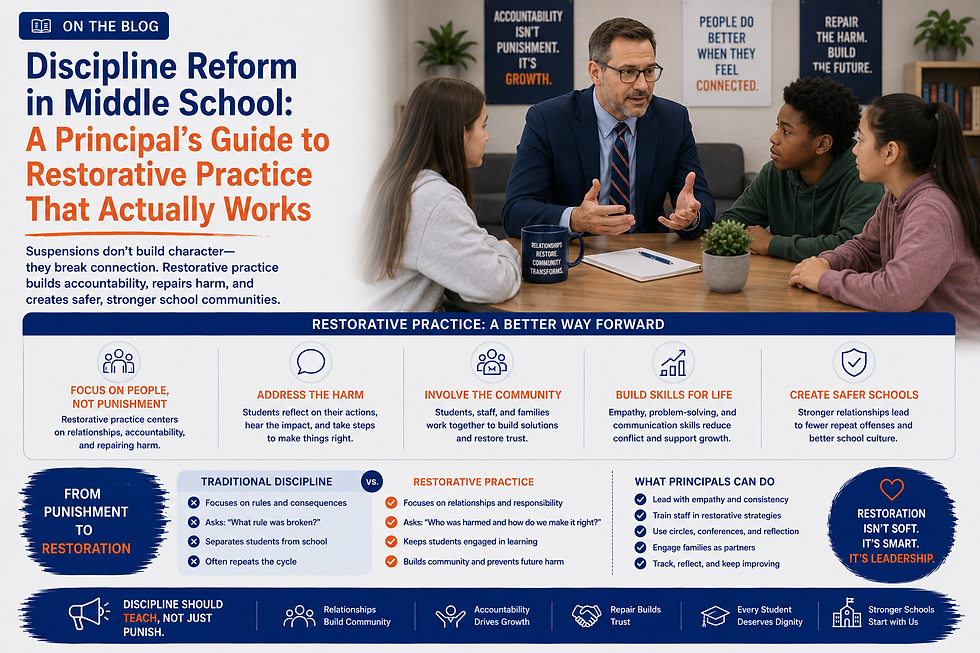
Why most restorative practice initiatives underperform — and what the research says is required to do this well in grades 6–8
The Issue: A Discipline System That Isn't Working
If you are a middle school principal in 2026, you are leading inside a school discipline system that, by most available measures, is not working — for students, for teachers, or for school climate.
The numbers tell a consistent story. According to the Learning Policy Institute's analysis of Civil Rights Data Collection figures, educators suspended secondary school students at much higher rates than elementary school students. In 2017–18, nearly 1 in 14 secondary school students (7%) were suspended — more than three times the rate of elementary school students (2%). Middle school is the grade band where the transition from elementary-level discipline to secondary-level exclusionary discipline accelerates rapidly.
The racial disparities embedded in these numbers have proven extraordinarily stubborn. Associated Press reporting in 2024, drawing on a decade of state-level discipline data, found that Black students in many states continue to receive a substantially disproportionate share of suspensions, expulsions, and removals to alternative schools. In California, the suspension rate for Black students fell from 13% in 2013 to 9% a decade later — but remained three times higher than the rate for white students.
A January 2025 brief from UCLA's Center for the Transformation of Schools, analyzing California suspension data through 2023–24, found that Black/African American and American Indian/Alaska Native students were suspended at nearly triple and quadruple the rate of the statewide average, respectively. The same analysis found that 10% of middle schools accounted for 35% of all middle school suspensions statewide — suggesting that while disparities are system-wide, the most exclusionary practices are concentrated in a small number of schools that have come to rely heavily on suspension as a discipline tool.
Brookings analysis of school suspension data reaches a similar conclusion: the racial disparity in suspensions is not primarily explained by differences in student behavior. Research consistently shows that Black students do not misbehave more than white students, but they receive harsher consequences for similar behaviors. The disparity is a system effect, not a student effect.
Meanwhile, Education Week's 2025 and 2026 State of Teaching surveys consistently identify student discipline as one of the top factors teachers say would meaningfully improve their morale. Teachers feel that current discipline systems are inconsistent, unfair, or ineffective — and that the lack of meaningful response to classroom disruption is a primary driver of their burnout and exit from the profession.
The result is a system that is failing on multiple dimensions at once: exclusionary discipline is over-applied, applied unequally, and yet still fails to produce the school climate teachers say they need to do their jobs. This is the discipline reality middle school principals are leading inside of. And it is the reason that "restorative practice" has emerged as the dominant discipline reform framework in K–12 education over the past decade.
Why Middle School Sits at the Center of Discipline Reform
Discipline reform conversations often focus on high schools, where the most visible consequences of exclusionary discipline — dropout, juvenile justice involvement, post-secondary outcomes — concentrate. But middle school is where the patterns are set.
The developmental window matters. Middle schoolers are forming their academic identity, their relationship to authority, their sense of belonging in school. A seventh grader who is suspended three times in a single year is a student whose relationship to school is being durably reshaped — typically in the direction of disengagement, distrust of adults, and academic withdrawal. The high school dropout pattern almost always begins in middle school.
The structural transition matters too. Students moving from elementary to middle school encounter a fundamentally different discipline system. In elementary school, a student typically has one primary teacher who knows them well, can interpret behavioral incidents in context, and has both the relational capital and the time to address issues without escalation. In middle school, a student has six or seven teachers, none of whom may know the whole child. Incidents are more likely to be referred up the chain. The administrator handling the referral typically has very little context. The result is more frequent reliance on standardized consequences — including suspension — for behaviors that in elementary school might have been handled relationally.
This structural shift is part of why middle school suspension rates jump so dramatically over elementary rates. It is not that twelve-year-olds are suddenly so much worse-behaved than ten-year-olds. It is that the system around them has become much less equipped to respond to their behavior with anything other than removal.
This is the system that restorative practice — and discipline reform more broadly — is attempting to transform. Whether that transformation succeeds depends almost entirely on implementation quality.
The Evidence: What the Research Actually Says About Restorative Practice
Restorative practice has been the dominant discipline reform framework in K–12 education for roughly a decade. The research base on its effectiveness is now substantial, and it tells a more nuanced story than either the framework's strongest advocates or its strongest critics typically acknowledge.
The positive findings. The Learning Policy Institute's 2024 study "Fostering Belonging, Transforming Schools", which combined data on restorative practices in 485 middle schools with detailed outcome data for approximately 2 million middle school students, found that schools that increased their use of restorative practices saw improvements in student behavior, school safety, and academic outcomes. School-level use of restorative practice was associated with declines in school-wide student misbehavior, gang membership, victimization, depressive symptoms, and substance abuse. Schools that increased utilization also saw improvements in average school GPA and school climate. Importantly, the associations were stronger for Black and Latino/a students than for white students, suggesting that restorative practices can help reduce racial disparities in discipline and academic achievement.
Earlier case-study evidence has also been encouraging. The Minnesota Department of Education's research synthesis cites the Oakland Unified School District experience, where Cole Middle School saw suspensions decline by 87% and expulsions decline to zero during a three-year implementation of whole-school restorative justice. Over a longer period, Oakland middle schools that implemented restorative practices saw a 24% reduction in chronic absence, and Oakland high schools that implemented the framework experienced a 56% decline in dropout rates compared with 17% for non-restorative-justice high schools.
A February 2025 systematic review published in Frontiers in Education, examining 13 studies of restorative practices in schools, found that restorative practices reduced violence, improved emotional wellbeing, and promoted socio-emotional skills.
The mixed findings. Not all of the research is positive. A 2019 randomized controlled trial of the Restorative Practices Intervention in 14 Maine middle schools found that middle school students who received the intervention did not report more school connectedness, better school climate, more positive peer relationships, or less victimization than students in control schools. Critically, the evaluation also found that the Restorative Practices Intervention in the study delivered only a modest amount of restorative practice experiences — an amount not much different from what control schools received. The intervention was tested, but it was not really implemented at the dosage the framework requires.
A 2022 RAND study published in the Journal of School Psychology, examining 14 elementary and middle schools in a large district, similarly found no statistically significant effects on four of five outcomes after one year of implementation. A follow-up analysis, however, showed that Black students in schools implementing restorative practices for two years experienced a greater reduction in suspensions than Black students in schools implementing the program for only one year.
The most rigorous synthesis of the evidence base, produced by researchers at Policy Analysis for California Education in 2023, concludes that available quantitative research generally indicates restorative practices can reduce schools' reliance on exclusionary discipline and show promise for ameliorating racial disparities in discipline. The evidence on academic outcomes is more mixed.
The pattern that emerges. Read together, the research base supports a clear conclusion: restorative practice works when it is genuinely implemented at high dosage and sustained over multiple years. Restorative practice does not work — or works only marginally — when it is adopted as a label without changing the underlying practice of the school. The difference between the success stories and the disappointing trials is almost always implementation fidelity.
What "Real" Restorative Practice Actually Requires
The implementation gap is so consistent across the research that it deserves direct attention. What separates schools that see real outcomes from schools that adopt the framework and see no change?
Time. The Oakland results that are most frequently cited took three years of whole-school implementation to materialize. The RAND follow-up analysis found that two-year implementation produced meaningfully better outcomes than one-year implementation. A school that announces a restorative practice initiative in August and expects measurable results by spring is operating on a timeline the evidence does not support.
Whole-school adoption. Restorative practice works as a culture, not as a discipline alternative. The schools where it succeeds are schools where every adult — not just the counselors, not just the trained facilitators — operates from restorative principles in their daily interactions with students. This is much harder than it sounds. It requires sustained professional development, ongoing coaching, and structural changes to how the school responds to incidents.
Real practice frequency. The Maine randomized trial found that the intervention condition delivered only a modest dose of restorative practice — not much more than what control schools were doing organically. The CDC's 2025 guidance on restorative practices similarly emphasizes that the framework requires consistent, frequent application of relationship-building and relationship-repair practices, not occasional use after incidents.
Genuine alternatives to suspension, not relabeling. The most common implementation failure is what might be called "restorative theater" — a school adopts the language of restorative practice but continues to rely heavily on suspension as the actual response to incidents. The label changes; the practice does not.
Adequate support resources. Restorative practice is staff-intensive. It requires trained facilitators, time for restorative conversations, space for circles, and ongoing professional development. Schools that adopt the framework without resourcing it adequately will see the framework collapse back into traditional discipline within a year or two.
The Structural Question Discipline Reform Often Skips
Beyond the implementation of restorative practice itself, there is a structural question that the most successful discipline reform efforts confront directly: what are the conditions of the school that drive disciplinary incidents in the first place?
This question is easy to skip. The framing of most discipline reform conversations is downstream — what should we do after an incident occurs? — rather than upstream — what conditions make incidents more or less frequent?
The structural drivers of middle school disciplinary incidents are well-documented. They include:
Phone-driven classroom disruption. A significant percentage of middle school disciplinary referrals in 2026 involve phone use in class, social media conflict that spills into school, or recorded incidents that escalate from confrontation to documented event. Schools with strong phone-free policies report substantial reductions in these incident categories.
Unstructured time. Hallway transitions, lunch periods, and unsupervised spaces are where many incidents originate. Strong adult presence and clear norms in these spaces prevent incidents that would otherwise generate referrals.
Classroom management variability. When some classrooms in a school have strong management and others do not, the school-wide referral rate climbs significantly. Investment in consistent classroom management across the building reduces incidents.
Predictable schedules and clear expectations. Schools with chaotic or constantly disrupted schedules generate more disciplinary incidents than schools with stable, predictable structures.
The school that combines real restorative practice with structural reduction of incident drivers will see substantially better outcomes than the school that only does one. The school that announces a restorative practice initiative while continuing to operate in structural conditions that produce constant disruption will see the framework strained beyond what it can absorb.
This is part of why structural interventions like decentralized phone-free policies — for example, the Safe Pouch system from Win Elements, a pouch that locks mechanically and releases only when a magnet with sufficient strength and the correct pattern is applied — are increasingly part of broader discipline reform conversations. They reduce the volume of incidents the discipline system has to absorb, which in turn makes restorative responses to remaining incidents more feasible at the dosage the framework requires.
For additional research on how structural school conditions connect to student behavior, school climate, and discipline outcomes, see the Win Elements research library.
The Practice: A Middle School Principal's Playbook for Discipline Reform
If you are a middle school principal trying to lead real discipline reform — not just adopt a label — here is a research-based sequence drawn from the evidence on what actually works.
Step 1: Map your current discipline data honestly
Before changing anything, document what your discipline system is actually producing. The data should answer:
What is your overall suspension rate, by grade level?
What are the racial and demographic disparities in your discipline outcomes?
What are the most common referral categories? (Many schools find that a small number of referral categories — willful defiance, disrespect, minor disruption — account for a disproportionate share of suspensions.)
Which classrooms generate the most referrals? Which adults generate the most referrals?
What is the recidivism pattern? How many of your suspended students are repeat suspensions?
The honest answer to these questions is usually uncomfortable. That is the point. Discipline reform that does not begin with unflinching data review is reform that will not survive contact with reality.
Step 2: Distinguish the categories of incidents that should never be exclusionary from those that may require it
Restorative practice is not a replacement for all discipline. It is a replacement for the categories of discipline that are most over-applied and most racially disparate — typically minor disruption, defiance, and disrespect.
A useful framework distinguishes:
Category A — Restorative response only: Minor disruption, defiance, disrespect, peer conflict, in-school relationship breakdowns. These should virtually never trigger suspension.
Category C — Structured consequence with restorative re-entry: Incidents involving safety, weapons, severe violence, or harassment that meet legal thresholds. These may require removal from school, but re-entry must include restorative work.
Without this distinction, restorative practice becomes either an empty label (everything still gets suspended) or an impractical absolute (nothing ever gets a structured consequence). Neither extreme is supported by the research or by what actually works in schools.
Step 3: Build the actual restorative capacity — not just the title
Implementation fidelity is what separates success from failure. Building real capacity requires:
Designated trained staff — typically one or more counselors or behavior specialists with formal training in restorative practice facilitation.
Sustained professional development for all staff — not a one-day workshop, but ongoing training and coaching over multiple years.
Time and space for circles and conferences — built into the schedule, not improvised between classes.
A clear protocol for what restorative response looks like in different incident categories.
Documentation systems that track restorative work alongside traditional discipline data, so the school can see what is working.
The schools that succeed at restorative practice typically have at least one full-time staff member whose primary job is the implementation. The schools that fail are typically the schools that "added restorative practice" to the existing responsibilities of an already-overburdened counselor.
Step 4: Address the structural drivers of incidents
Real discipline reform reduces both the over-application of suspension and the volume of incidents that have to be responded to in the first place. The upstream moves matter as much as the downstream ones.
Concrete moves:
A genuinely enforced phone-free school day. This is one of the single highest-leverage moves available to middle school principals concerned with discipline reform. The category of incidents involving phone-driven disruption, social media conflict, and recorded confrontations is large and growing. Removing the device structurally — through enforcement systems that don't depend on per-classroom teacher policing — reduces incident volume substantially.
Strong, consistent classroom management across all classrooms.
Clear schoolwide behavioral expectations that every adult reinforces consistently.
Adult presence and engagement during unstructured time (passing periods, lunch, before and after school).
Proactive relationship-building — homeroom advisory, mentoring, daily check-ins — that builds the relational fabric restorative practice depends on.
Step 5: Train every adult — including the ones who think they don't need it
Restorative practice fails most often when it remains the property of a small group of trained staff while the rest of the school continues to operate from traditional discipline assumptions.
Real implementation includes:
Initial training for every staff member, including paraprofessionals, support staff, and substitutes.
Annual refreshers.
Ongoing coaching from trained facilitators.
Clear communication about what restorative practice is and is not — including the explicit reality that it is not "no consequences" but rather "different and often more demanding consequences."
The skeptical veteran teacher who believes restorative practice is permissive is often skeptical because they have only seen the label adopted without the underlying practice. Their skepticism is reasonable. The answer is to actually implement the practice, not to wish away the skepticism.
Step 6: Engage families as partners
Many of the incidents that lead to disciplinary referral involve dynamics that extend beyond the school day. Families are essential partners in restorative work, but they need to be engaged thoughtfully.
Family engagement in discipline reform includes:
Clear, plain-language communication about how the school's discipline approach works.
Real participation in restorative conferences when appropriate.
Honest communication about both their child's behavior and the school's response.
A pathway for families to raise concerns about discipline decisions or the consistency of enforcement.
Step 7: Commit to multi-year implementation
The research is consistent on this point: restorative practice produces meaningful outcomes when implemented well over multiple years. Schools that expect results in year one will be disappointed. Schools that commit to a three-to-five-year arc and protect the implementation from competing initiatives will see the change.
This is a leadership commitment that has to outlast a single school year, a single school board cycle, and the inevitable pressure to revert to familiar approaches when incidents occur.
Step 8: Monitor outcomes carefully — and adjust
Discipline reform is not a fire-and-forget initiative. The schools that succeed track outcomes carefully and adjust implementation based on what the data shows:
Suspension rates, by grade and subgroup.
Referral patterns by teacher and classroom.
Recidivism rates among students receiving restorative intervention.
School climate survey data from students and staff.
Academic outcomes for students who have engaged with restorative processes.
If the data shows the approach is not working in your context, adjust the implementation. The framework is not the goal — student and school outcomes are.
What the Research Still Doesn't Tell Us
Honest leadership requires acknowledging the limits of current evidence.
What are the longest-term outcomes of restorative practice? Most studies look at one-to-three-year windows. The decade-plus longitudinal evidence on what happens to students who go through restorative middle school discipline systems is still developing.
Which specific restorative practices matter most? The framework includes many distinct practices — community-building circles, harm circles, restorative conferences, peer mediation, classroom-level relational practices. The research is clearer that the framework as a whole shows promise than about which specific components carry the most weight.
How does restorative practice interact with the broader discipline policy environment? State-level discipline policy varies widely, and the interaction between state law (which in some states is becoming more punitive) and school-level restorative implementation is not well-studied.
The Bottom Line for Middle School Principals
The discipline system most middle schools currently operate is failing on multiple dimensions at once. It over-applies exclusionary consequences, it does so unequally across demographic groups, and it still fails to produce the school climate teachers say they need to do their work. The research base on restorative practice as an alternative is real but conditional: the framework works when it is genuinely implemented over multiple years with adequate resources and whole-school adoption. It does not work — or works only marginally — when adopted as a label without the underlying practice.
Discipline reform is one of the most consequential leadership projects a middle school principal can take on. The students who pass through your school's discipline system in grades 6, 7, and 8 are forming durable patterns of academic identity, relationship to authority, and trust in institutions. The teachers in your building are watching whether the school's stated commitments translate into the structural support they need. The families you serve are watching whether the policy on paper becomes practice.
The structural moves — protected restorative capacity, real teacher training, upstream incident reduction, multi-year commitment — are within your authority. The research supports them. The students need them.
Lead the implementation. The label follows.
Sources Cited
Learning Policy Institute. "Pushed Out: Trends and Disparities in Out-of-School Suspension." 2024.
Alonso-Rodríguez I, et al. "Restorative practices in reducing school violence: a systematic review of positive impacts on emotional wellbeing." Frontiers in Education, February 2025.
Augustine C, et al. "Restorative Practices: Using local evidence on costs and student outcomes to inform school district decisions about behavioral interventions." Journal of School Psychology, 2022.
Brookings Institution. "Racial disparities in school suspensions."
Minnesota Department of Education. "Restorative Practices in Schools Research."
California Department of Education. "Restorative Practices and School Discipline."



Comments