

Phone-Free Schools: A Middle School Principal's Guide to Leading the Transition From Policy to Real Enforcement
- John Nguyen
- 2 days ago
- 13 min read
How to move beyond "off and away" rules that don't work and build a structurally enforced phone-free environment that actually changes your school's climate
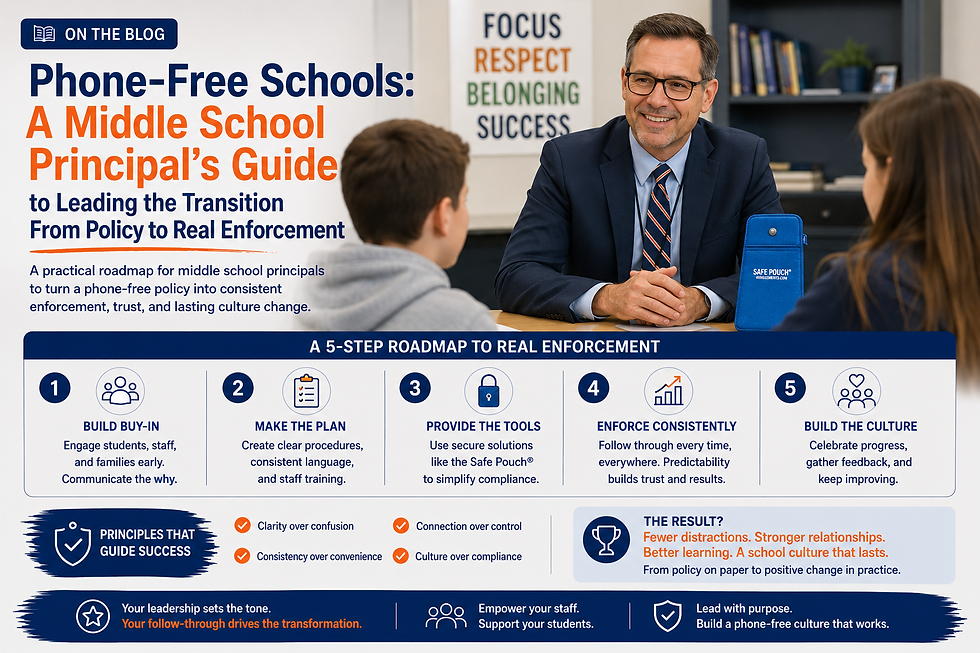
The Issue: Policy Has Outpaced Practice
If you're a middle school principal in 2026, you are almost certainly already operating under some form of phone restriction. The question is no longer whether to have a phone policy — it's whether the policy you have is actually working.
The numbers tell the story clearly. According to data from the National Center for Education Statistics, 77% of public schools now prohibit student cell phone use during class. In middle schools specifically, that figure climbs higher — 78% of middle schools have full classroom phone prohibitions, according to findings from the RAND Corporation's 2024–25 American School Leader Panel survey. As of October 2025, 31 states and the District of Columbia had passed laws or executive orders restricting K–12 cell phone use, with most of those actions occurring in 2025 alone.
And yet, despite this remarkable policy momentum, RAND's research surfaces an uncomfortable truth that every middle school principal already knows in their gut: one-half of middle and high school students still check their phones during class at least once a day — even in schools with more restrictive cell phone policies.
The gap is not about will. It's about enforcement.
Melissa Kay Diliberti, the RAND associate policy researcher who led the principal survey, identified the missing piece directly. In comments to Education Week, Diliberti said: "What's missing from all of the knowledge that we have on cellphone bans thus far is what enforcement of the bans looks like. How strict are teachers when it comes to enforcing the ban? How much time are they spending enforcing the ban? And does that time take away from other activities in the classroom?"
For middle school principals, those questions are not academic. They are the daily reality of trying to teach in an environment where the average adolescent receives up to 200 notifications a day, where 97% of students use phones at school, and where the typical adolescent spends 66 minutes per day on their smartphone during school hours, according to research published in JAMA Health Forum in October 2025.
Why Middle School Is the Inflection Point
Among all grade levels, middle school is where the phone problem most urgently needs structural answers — and where leadership matters most.
Middle schoolers are developmentally at the moment when peer comparison, social validation, and identity formation become the central drivers of their psychology. Drop a smartphone with social media access into that developmental window and the results are predictable: increased anxiety, social comparison spirals, disrupted sleep, distracted learning, and a surge in opportunities for cyberbullying. According to research published by the Digital Wellness Lab, 54% of LGBTQ+ middle schoolers report being cyberbullied — significantly higher than the general adolescent rate.
It is also at the middle school level where the social weaponization of the smartphone camera reaches its most damaging form. Two-thirds of principals in the RAND survey reported that phone bans reduced incidents of students photographing classmates in restrooms or locker rooms, or recording and streaming physical fights at school. Those are not minor disruptions. They are the kind of incidents that traumatize victims, fracture school climate, and consume hundreds of administrative hours per year.
For middle school principals, this means the stakes of getting your phone policy right are unusually high. A policy that exists on paper but fails in practice is worse than no policy at all — it teaches students that adult rules don't actually have weight, and it leaves the most vulnerable children exposed to harms the policy was supposed to prevent.
The Evidence: When Phone Policies Are Structurally Enforced, They Work
The good news for principals is that when phone-free policies are implemented with real structural enforcement, the evidence is clear and consistent.
RAND's October 2025 report, which surveyed approximately 8,000 K–12 principals, found that 86% of principals in schools with phone restrictions endorsed safety-related benefits. The most commonly cited benefits:
Improved school climate — Nearly three in four principals reported a positive impact on overall school climate.
Reduced inappropriate cell phone use — Two-thirds of principals reported a decrease in students using phones to photograph classmates inappropriately or record fights.
Reduced cyberbullying — 54% of principals reported that phone bans had reduced cyberbullying that begins during school hours.
Fewer distractions during emergencies — 44% of principals reported decreased student distraction during emergency drills and actual emergencies.
These findings are not based on hunches. They are based on the largest nationally representative survey of school leaders ever conducted on this question.
Causal evidence is now emerging too. A working paper released in October 2025 by the National Bureau of Economic Research, authored by University of Rochester economist David Figlio and RAND senior economist Umut Özek, analyzed cellphone activity data from a large urban Florida school district following the state's 2023 cell phone restrictions. The researchers compared schools that had high cellphone activity before the ban with those that had low usage. In the second year of the ban, test scores on the higher-stakes spring assessment increased by 1.1 percentiles more in schools where students had previously used their phones heavily — with effects more significant for middle and high school students.
Notably, the Florida study also found that improvements in attendance contributed to roughly half of the test score gains. In other words, phone-free environments did not just help students focus — they made students more likely to come to school in the first place.
Additional findings from the Phones in Focus research project, based on a survey of more than 20,000 public school educators, reinforced the pattern. Lead researcher and University of Pennsylvania psychologist Angela Duckworth summarized the findings plainly: "The stricter the policy, the happier the teacher and the less likely students are to be using their phones when they aren't supposed to."
Strictness, in this context, is not philosophical. It is structural.
For principals who want to review the broader research base before making a decision, the Win Elements research library compiles peer-reviewed studies, state policy data, and implementation case studies in one place.
The Solution: From "Off and Away" to Bell-to-Bell — and From Centralized to Decentralized Enforcement
The phone policies that produce real change share a common feature: they do not rely on students choosing not to use their phones. They make it physically impossible during the school day.
Education policy research has converged on three policy frameworks, in ascending order of effectiveness:
1. Off-and-away policies. Students keep phones on their person but are expected to leave them in pockets or backpacks during class. These are the most common and the least effective. They depend entirely on teacher enforcement, which means they consume instructional time and create constant conflict points throughout the school day.
2. Classroom storage policies. Students place phones in a designated classroom location — a basket, a wall organizer, a charging station — at the start of each class. Better than off-and-away because phones are physically removed from the student's reach, but the policy resets every period and creates handoff friction.
3. Bell-to-bell containment. Students place their phones in a secured location at the start of the school day and do not access them again until dismissal. This is the gold standard endorsed by Massachusetts Attorney General Andrea Campbell in her January 2025 Cell Phones & Social Media in Schools Toolkit, and recommended by the Distraction-Free Schools Policy Project's Model Bill. Two-thirds of principals nationally now report having a bell-to-bell policy at their school, according to the RAND survey.
Bell-to-bell containment is the only approach for which the evidence consistently shows substantial improvements in school climate, behavior referrals, and student focus.
But within bell-to-bell, there is another decision principals must make — one that the research community is just beginning to address but that practitioners on the ground have learned the hard way. It is the difference between centralized and decentralized enforcement.
Centralized enforcement relies on a single unlocking station — usually at a school exit — where every student must line up at dismissal to release their phone. This is the model many early pouch programs adopted. It works in theory. In practice, it creates dismissal bottlenecks, single points of failure, and an enforcement burden that falls on whatever staff member is stationed at the unlocking base. When that staff member is sick or pulled into another duty, the entire system breaks.
Decentralized enforcement distributes unlocking authority across every classroom. Each teacher carries their own unlocking magnet. Each administrator carries their own. There is no bottleneck, no single point of failure, no line at dismissal. When a student needs phone access for an emergency, a medical reason, or a legitimate instructional purpose, the nearest authorized adult can unlock the pouch immediately.
This is the model behind the Safe Pouch system from Win Elements, a patented decentralized locking phone pouch system (U.S. Pat. No. 10,980,324) built specifically to solve the enforcement problem RAND researchers identified. Every teacher unlocks. Every administrator unlocks. Anytime, anywhere — no central base, no bottleneck. The system was designed for the classroom and scaled across the school, rather than the other way around.
The decentralized approach has become the dominant model in well-implemented bell-to-bell schools precisely because it solves the structural failure point that has caused so many centralized programs to collapse in their second or third year. Delaware's $250,000 state pilot program and Pennsylvania's $100 million cellphone lockup fund reflect the growing investment in physical pouch-based solutions — and the difference between programs that thrive and programs that quietly fade is almost always whether enforcement is structurally distributed or structurally bottlenecked.
The Practice: A Middle School Principal's Implementation Playbook
If you are a middle school principal preparing to move from a paper policy to a real one, here is a practical sequence drawn from research and the documented experience of principals who have done it successfully.
Step 1: Diagnose your current policy gap
Before implementing anything new, gather honest data on what is happening in your building right now.
Walk through five random classrooms in a single morning. Count how many students have phones visible, in pockets, or actively being used.
Pull your behavior referral data for the past 90 days. Tag every referral that involved a phone — recording a fight, posting an incident to social media, taking unauthorized photos, using a phone during a test, sending inappropriate messages.
Ask three of your strongest teachers, privately, how much instructional time they lose per week to phone-related interventions.
You will almost certainly find that your current policy is consuming far more teacher energy than you realize — and that the policy as written has very little relationship to what is actually happening in classrooms.
Step 2: Choose your enforcement mechanism before you write the policy
The single most common mistake in implementing a phone-free policy is to write the policy first and figure out enforcement second. This sequence guarantees failure.
The right sequence is to choose your enforcement mechanism first and then build the policy around it. Your options:
Classroom storage (cubbies, pocket charts, wall organizers) — Low cost, but requires per-period enforcement and creates a target for theft or tampering.
Locked phone storage at school entry (locked lockers, classroom safes) — Medium cost, removes phones entirely but creates morning and dismissal bottlenecks.
Decentralized locking pouches — Students keep their phones on their person inside a magnetically secured pouch that is locked at the start of the day and unlocked at dismissal by any authorized adult. Eliminates classroom enforcement entirely, preserves student ownership of the device, and removes the central-base bottleneck that breaks down most pouch programs. The Safe Pouch decentralized kit is the only system currently designed around this protocol.
The decision is largely determined by school size and emergency-response priorities. For middle schools above 400 students, decentralized pouches are typically the only enforcement model that scales without creating new operational problems.
If budget is the immediate barrier, your district may qualify for state pilot funding, federal mental health grants, or Title IV-A funds. Win Elements has compiled current funding pathways for school cell phone programs here.
Step 3: Build stakeholder alignment before launch — especially with parents
Parent surveys consistently identify one concern above all others: the ability to reach their child during an emergency. Twenty-one percent of principals in the RAND survey reported increased parent concern about emergency contact as a documented drawback of phone bans.
Address this concern directly and proactively, before parents raise it. The strongest implementations build the following into their family communications:
A clear protocol for how parents can reach the front office during emergencies.
A reciprocal commitment from the school that parents will receive timely communication during any incident.
Specific exceptions for students with documented medical needs, IEPs that require device access, or other accommodations.
A demonstration of the unlocking mechanism at back-to-school night, so parents can see the system is not punitive — and so they understand that decentralized unlocking means their child can reach them within seconds in any genuine emergency, from any classroom.
Most parental resistance to phone-free policies is not actually about phones. It is about trust. Build the trust first. The decentralized model is particularly powerful here because it dismantles the most common parental fear — that a phone locked in a centralized base is unreachable when it matters most.
Step 4: Train your staff on consistent enforcement — not heroic enforcement
In the early weeks of any new policy, the difference between success and failure is whether enforcement is consistent across every adult in the building. One teacher who lets students keep their phones because "they're using them for notes" can undermine months of policy work.
Hold a mandatory staff training before launch that covers:
The specific physical actions required (where phones go, when, how).
The standard response to any student who is non-compliant (no negotiation, no exceptions, single referral path).
The communication script for parents who call with questions.
The plan for managing the emotional resistance that will inevitably appear in the first two weeks.
Make clear that enforcement is not the individual teacher's responsibility — it is the school's responsibility, executed consistently by every adult. Decentralized systems make this dramatically easier because each teacher already holds the tool needed to unlock a pouch in legitimate circumstances. There is no "I have to send the student down to the office" friction that erodes consistent enforcement over time.
Step 5: Pilot, measure, scale
If your school has more than 600 students, consider piloting your new system with one grade level (typically sixth grade) for 30 to 60 days before scaling school-wide. This gives you:
A controlled environment to surface and solve implementation issues.
Concrete data — behavior referrals, attendance, teacher satisfaction — to present to your school board, district leadership, and parent community before broader rollout.
A cohort of students who become the policy's strongest advocates as they move to seventh grade.
Track at minimum: phone-related behavior referrals, total behavior referrals, average daily attendance, teacher satisfaction (via a 5-question monthly survey), and incidents of cyberbullying that originate during the school day.
You can request a Safe Pouch sample for your pilot at no cost, allowing your leadership team and a small group of teachers to test the decentralized unlocking system before any procurement decision.
Step 6: Communicate the wins
Once your data shows the policy is working — and the research strongly suggests it will — communicate it. To your staff, to your parents, to your district leadership, to your students themselves.
The students who initially resisted the policy most loudly are often the first to report feeling less stressed and more socially engaged once the phones are out of the equation. In RAND's American Youth Panel survey, six in ten students said they support phone restrictions during class because the restrictions reduce distractions. That signal — that students themselves see the benefits — is one of the most powerful tools you have for sustaining the policy long-term.
You can also draw on real implementation stories from other middle schools. The Win Elements testimonials page collects documented experiences from districts that have implemented decentralized pouch-based phone-free policies — useful both as internal validation and as evidence for skeptical board members.
What the Research Still Doesn't Tell Us
Honest leadership requires acknowledging what we don't yet know.
The Figlio and Özek Florida study found that while overall outcomes improved after the cell phone ban, Black students experienced disproportionate disciplinary costs in the first year — though the disparity largely faded in the second year as implementation matured. The lead author, David Figlio, framed the finding as a call for principals to be thoughtful about enforcement, not as a reason to abandon the policy.
A scoping review of 22 studies across 12 countries, led by researcher Marilyn Campbell and colleagues and published in 2024, characterized the direct evidence base on phone bans and mental health as still mixed. The most recent rigorous studies — including the Lancet Regional Health study published in 2025 — are beginning to fill that gap, but a strong middle school principal should hold the evidence with appropriate humility. We know phone-free schools improve climate, focus, and behavior referrals. We have growing causal evidence on academic outcomes. We have less robust direct evidence on mental health outcomes, though the mechanism — reduced cyberbullying, reduced social media exposure, increased face-to-face connection — is well-established.
The leadership question is not whether the evidence is complete. It is whether the evidence is strong enough to act on. For phone-free policies in middle schools, the answer is yes.
The Bottom Line for Middle School Leaders
A phone policy that is enforced by the structure of your school day will outperform a phone policy that depends on the moment-by-moment willpower of teachers and students. This is not a controversial claim. It is the consistent finding of every major study published on this topic in the past two years.
Your job as a middle school principal is to build the structure. The policy itself is the easy part. The structural enforcement — whether through pouches, lockers, classroom storage, or some combination — is the part that determines whether your school changes or whether you just have another rule that everyone agrees is important and nobody actually follows.
The schools getting this right are the ones treating phone policy not as a discipline issue but as a school climate intervention. They are measuring outcomes, communicating wins, supporting their teachers, and respecting their students' eventual return to their devices at the end of the day. They are, increasingly, choosing decentralized enforcement models — like the Safe Pouch system — that distribute unlocking authority to every adult in the building rather than concentrating it in a single bottleneck.
The students at your school are watching how you handle this. So are the teachers, the parents, the community. Phone policy has become one of the most visible leadership tests middle school principals face today. The good news is that you do not have to invent the answer. The research is in. The model exists. The path forward is clear.
It just takes a principal willing to walk it.
Ready to explore what decentralized enforcement looks like in your building? Request a free Safe Pouch sample, review current research and case studies, or get a quote for your school.
Sources Cited
Cantor J, et al. "Cell Phone Bans in a National Sample of US Public School Principals." JAMA Health Forum, October 2025.
Klein A. "Why Most Principals Say Cellphone Bans Improve School Climate." Education Week, October 2025.
Arundel K. "Most school leaders report cellphone restrictions, widely seen as beneficial." K-12 Dive, October 9, 2025.
Meltzer E. "School cellphone bans have spread with little hard data. A new study finds benefits and costs." Chalkbeat, October 2025.
Digital Wellness Lab. "The Online Experiences of LGBTQ+ Youth." February 2025.
Phone-Free Schools State Report Card / Distraction-Free Schools Policy Project.
Cyberbullying Research Center. "Student Phones, School Bans, and Youth Mental Health."
Massachusetts Attorney General. Cell Phones & Social Media in Schools Toolkit, January 2025.


Comments