

Special Education and Inclusion Leadership in Middle School: A Principal's Guide to Co-Teaching, IEPs, and the Decisions That Determine Real Access
- John Nguyen
- 1 day ago
- 16 min read
Why inclusion is the law of the land, why it often fails in practice, and what middle school principals can do to make it work
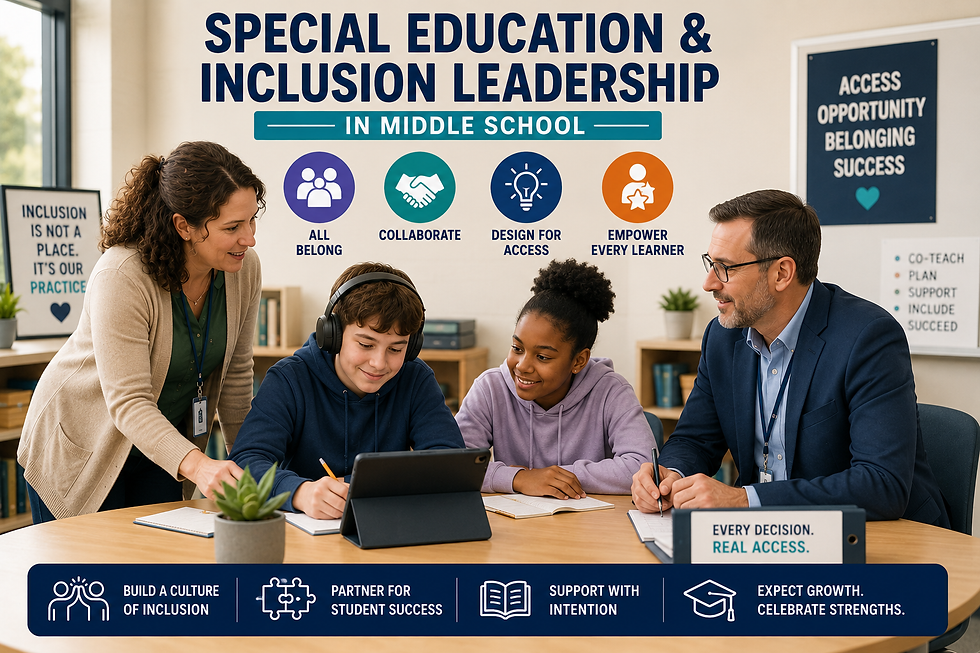
The Issue: A Federal Mandate That Often Fails in Practice
If you are a middle school principal, special education is not a peripheral part of your job. According to the U.S. Department of Education's September 2024 guidance on inclusive educational practices, nearly 70 percent of children with disabilities spend more than 80 percent of their school day in the general education classroom. Inclusion is no longer the educational philosophy of a progressive minority. It is the operational reality of how special education is delivered in American schools.
This represents one of the most significant shifts in K–12 education over the past three decades. The Individuals with Disabilities Education Act (IDEA), through its requirement that students with disabilities be educated in the Least Restrictive Environment, has fundamentally restructured how schools approach disability. The self-contained classroom model that defined special education for most of the twentieth century has been replaced, for most students, by varying configurations of general education placement with supplementary aids and services.
And yet — inclusion, as actually implemented in many middle schools in 2026, is failing.
The research is increasingly clear on the gap between the policy framework and the operational reality. A November 2025 systematic review published in the European Journal of Special Needs Education, examining 21 studies of inclusive education in secondary schools (ages 11–17), found that students with special educational needs have higher achievement and make more academic progress in inclusive settings — when inclusion is implemented well. The same review documents that implementation quality varies enormously, and that the headline finding masks substantial heterogeneity in outcomes depending on what schools actually do.
A more skeptical 2022 Education Next review noted that the empirical research on inclusion suffers from significant methodological limitations — selection effects, the difficulty of disentangling placement from quality, and the absence of randomized comparisons make causal claims about inclusion's effects unusually difficult. The honest answer is that the existing research base supports inclusion as a principled framework but does not yet support strong causal claims about average outcomes.
The Hechinger Report's analysis of a recent inclusion research review captured the consensus among practitioners and researchers: "Inclusion, just in general, doesn't increase outcomes. Just like exclusion, just in general, doesn't help anyone. So many other things have to be true. What the kids and adults are actually doing when they are being 'included,' matters the most."
This is the leadership reality middle school principals are operating inside of. Inclusion is the legal framework, the operational default, and the evidence-supported approach — when done well. When done poorly, it produces outcomes that are no better, and in some cases worse, than the segregated settings it replaced.
The middle school principal's leadership work is not to choose between inclusion and segregation. That choice has largely been made by federal law. The leadership work is to ensure that the inclusion their school practices is the kind the evidence supports — not the kind that exists on paper while students with disabilities sit in general education classrooms without the supports that make placement meaningful.
This article is for middle school principals who want to lead special education and inclusion with substance rather than compliance — and who understand that the decisions they make about co-teaching, scheduling, staffing, and IEP team practice will determine, more than any other variable, whether their students with disabilities actually have access to the education the law requires.
Why Middle School Sits at a Particularly Difficult Point in the Inclusion Landscape
Middle school is widely understood, both by special education researchers and by practitioners, to be the most operationally complex grade band for inclusion. The reasons are structural.
The departmentalization problem. Elementary schools typically have one primary teacher per classroom. A student with an IEP in fourth grade is supported by one general education teacher who knows them well, with the special educator pushing in or pulling out as needed. Middle schools fragment this structure into six or seven teachers per student, none of whom may have the depth of relationship that elementary teachers do. The cognitive load of implementing IEP accommodations consistently across six classrooms is substantially higher than implementing them in one — and the implementation quality varies accordingly.
The content-area expertise problem. Middle school is where content specialization begins to matter. Mathematics, English language arts, science, and social studies require subject-specific expertise that becomes increasingly difficult to combine with deep special education expertise in a single person. The co-teaching model that works well in elementary schools — where the general educator is a generalist and the special educator can also be a generalist — does not transfer cleanly to middle school, where the general educator is a content expert and most special educators have not been trained as content experts in any of the four core areas.
The peer dynamics problem. Early adolescence is the developmental window when peer perception becomes most acute. Students with disabilities in middle school are intensely attuned to how their accommodations, supports, or pull-out services are perceived by peers. Inclusion practices that work in elementary school — where peer attention to disability is more diffuse — produce different social effects in middle school, where peer attention to anything that marks a student as different is intense.
The transition consequence problem. Middle school is the grade band where IEP and 504 decisions begin to have durable post-secondary consequences. Course placement, credit accumulation, and academic trajectory in grades 6–8 substantially shape high school placement, post-secondary access, and adult outcomes. The IEP team decisions made at the middle school level carry weight that elementary IEP decisions do not.
The behavioral complexity problem. Many students whose disabilities involve behavioral, emotional, or social dimensions enter middle school at the most volatile developmental window for those manifestations. The student who managed an attention or anxiety condition adequately in elementary school may struggle dramatically in middle school as the cognitive, social, and structural demands change. Schools that have not adapted their IEP and behavioral support practices to this reality see disproportionate behavioral incidents involving students with disabilities — and disproportionate discipline outcomes that compound the original disability.
This is the structural reality middle school principals are leading inside of. And it is the reason that special education leadership in middle school requires substantively different work than leadership in elementary or high school settings.
The Evidence: What Real Inclusion Actually Requires
The research literature on what makes inclusion work — as opposed to inclusion as label — has converged on a relatively clear set of conditions over the past decade.
Condition 1: Quality co-teaching with both content expertise and special education expertise. A 2010 ERIC study on inclusion classrooms found that co-teaching was moderately effective in improving student outcomes when implemented well, and that the social and emotional benefits of co-teaching — particularly around peer relationships — were more consistently documented than the academic benefits. Subsequent research has refined this finding. The co-teaching that works includes both teachers operating as content experts, sustained time spent in small-group instruction rather than whole-group lecture, joint planning time built into the schedule, and a genuine collaborative relationship rather than a "general teacher teaches, special teacher floats" pattern.
Condition 2: Joint planning time, structurally protected. The systematic review of cooperation between regular teachers and special educators published in 2020 consistently identifies joint planning time as one of the most predictive factors in whether co-teaching produces strong outcomes. Co-teaching pairs that share planning time produce meaningfully different outcomes than co-teaching pairs who try to coordinate around the edges of the day. Protecting this time is a scheduling decision, not a programmatic one.
Condition 3: Administrative support visible at the building level. The 2020 systematic review explicitly identifies administrative support as one of the most important factors distinguishing schools where inclusion produces outcomes from schools where it does not. The principal's visible engagement with the special education team, attendance at IEP meetings for high-stakes cases, support for co-planning time and structural decisions, and willingness to address concerns from general educators about inclusion practice all matter.
Condition 4: The Least Restrictive Environment as a continuum, not a default. The federal guidance is clear that inclusion is not a single placement decision but a continuum, and that placement decisions are properly made by IEP teams based on individual student needs. As the Hechinger Report analysis notes: "A non-verbal student with autism is NOT categorically better off in an autism classroom than in an inclusion classroom with strong language modeling — but it depends on whether the inclusion classroom actually has strong language modeling." The placement decision is downstream of the question of what supports are actually available in the proposed placement.
Condition 5: Specially designed instruction that is genuinely specialized. The Department of Education's 2024 guidance emphasizes that the LEA must provide specially designed instruction addressing the unique needs of the child that result from the disability and ensuring access to the general curriculum. The most common failure mode in inclusion practice is general education delivered with minor accommodations being labeled as "specially designed instruction" without the substantive instructional adaptation the law actually requires.
Condition 6: Universal Design for Learning at the school level. Schools that successfully include students with disabilities typically do so within a Universal Design for Learning framework — instructional design that anticipates variability among learners and builds in flexibility from the start, rather than retrofitting accommodations onto rigid instruction after the fact. UDL is not a special education framework. It is a general education framework that makes special education work better.
Condition 7: Genuine collaboration with families. The Campbell Collaboration systematic review on inclusion effects published in 2022 found that family engagement and collaboration with educators are consistently predictive of better outcomes for students with special educational needs. The most effective inclusion programs treat families as substantive partners in IEP development and instructional decision-making, not as audiences for compliance documents.
The cumulative picture is that real inclusion is structurally demanding. It requires staffing, scheduling, planning time, professional development, administrative attention, and family partnership that go well beyond what most middle schools resource. The schools that do inclusion well are not the schools with the most progressive philosophy. They are the schools that have made the operational commitments inclusion actually requires.
The Compliance Trap: Why Most Middle Schools Stay Stuck
A pattern that appears repeatedly in special education practice in middle schools deserves direct attention: the compliance trap.
The compliance trap is the pattern of treating special education leadership as primarily a matter of regulatory compliance — IEP documents complete, accommodations listed, timelines met, paperwork filed — without the substantive instructional and structural work that compliance is supposed to enable. Schools in the compliance trap can have flawless IEP documentation, on-time meetings, fully signed paperwork, and students with disabilities sitting in general education classrooms — while those students receive no meaningfully different instruction than they would receive in a school with no inclusion framework at all.
The compliance trap is seductive because it is measurable. Documentation compliance is easy to track, easy to audit, and easy to demonstrate to district leadership. Substantive instructional quality is harder to measure, harder to audit, and harder to demonstrate. The path of least resistance for a busy middle school principal is to focus on the compliance work and assume the substantive work is happening downstream.
It usually is not.
The way out of the compliance trap is to organize the school's special education leadership around the question of whether students with disabilities are actually receiving instruction that is different from what they would receive without an IEP — and whether that instruction is producing access to the general curriculum, growth on IEP goals, and measurable progress over time. The compliance work matters, but it is a means to an end, not the end itself.
The Structural Layer Most Schools Underestimate
Beyond the specific practices that make inclusion work, there is a structural reality that middle school special education leadership often ignores: the daily conditions of the school as a whole substantially shape whether students with disabilities can succeed in inclusive settings.
The structural conditions that matter for students with disabilities include:
Classroom management consistency. Students with disabilities — particularly those whose disabilities involve attention, executive function, or behavioral regulation — are disproportionately affected by inconsistent classroom management. The student who can succeed in a well-managed classroom may struggle dramatically in a poorly managed one. Schools where classroom management varies widely across the building have inclusion programs that vary widely in their effectiveness.
Predictable schedules and minimal disruption. Students with disabilities often depend on predictability more than their peers do. Schools that frequently disrupt schedules — assemblies, special programs, last-minute changes — create cognitive load that disproportionately affects students with disabilities. Schools that maintain predictable structure see inclusion work more effectively.
The phone and digital environment. Many students with disabilities — particularly those with ADHD, autism spectrum conditions, and anxiety disorders — are disproportionately affected by digital distraction. Smartphone access during instructional time creates focus demands that students with attentional disabilities cannot meet without exhausting their cognitive resources. Schools that have implemented decentralized phone-free school days — for example, the Safe Pouch system from Win Elements, in which every adult has unlocking authority — often report that students with disabilities show some of the most pronounced benefits from the structural change. The classroom that is free of the constant interruption of social media and notifications is the classroom in which co-teaching, small-group instruction, and Universal Design for Learning can actually function as designed.
The mental health infrastructure. Many students with disabilities have co-occurring mental health needs. Schools with strong mental health infrastructure — counselors, social workers, MTSS supports — produce substantially better outcomes for students with disabilities than schools without it. The special education team cannot substitute for the broader mental health capacity of the school.
For additional research on how structural school conditions — including phone policy, climate, and classroom focus — affect student attention, learning, and inclusion outcomes, see the Win Elements research library.
The Practice: A Middle School Principal's Playbook for Real Special Education Leadership
If you are a middle school principal trying to lead special education and inclusion with substance rather than compliance, here is a research-based sequence drawn from the strongest current evidence.
Step 1: Audit your inclusion practice honestly
Before changing anything, document what your school's special education and inclusion practice actually looks like — not what the documentation says, but what is happening in classrooms. The honest questions:
What percentage of students with IEPs are in general education classrooms, and for what percentage of their day?
In those classrooms, what does instruction actually look like? Are there meaningful small-group instructional moments? Is there co-teaching with shared planning?
What are the academic outcomes for students with IEPs in your building — by disability category, by grade level, by classroom?
What are the behavioral and discipline outcomes for students with IEPs?
How do your students with IEPs feel about their experience? (Their self-report often differs significantly from what staff observe.)
What do general education teachers feel they need to support students with IEPs that they currently lack?
The honest answers to these questions usually surface significant gaps between policy and practice. That is the starting point for substantive leadership.
Step 2: Protect joint planning time as a structural condition
The single most consistently identified factor in successful co-teaching is structured joint planning time between general educators and special educators. Without it, co-teaching deteriorates into "general teacher teaches, special teacher floats" within a semester.
Protecting joint planning time requires:
Building it into the master schedule — not retrofitting around the edges.
Treating it as inviolable — not eligible for cancellation for general meetings or coverage requests.
Tracking that it is actually happening — co-teaching pairs should be able to point to specific planning sessions per week.
Providing structure and accountability — joint planning is not a casual conversation; it has expected outputs (shared lesson plans, agreed-upon assessment adaptations, behavior support plans, family communication coordination).
If you cannot protect joint planning time, you cannot do co-teaching well. The scheduling decision is the most consequential decision the principal makes in this domain.
Step 3: Build content expertise into special education staffing
The middle school co-teaching problem is partly a staffing problem. Special educators trained as elementary generalists or as resource room specialists often struggle in middle school content classrooms where the general educator is a content expert. The student support that results is uneven.
Practical moves:
Hire special educators with content expertise in the core areas — math, ELA, science, social studies — when possible.
Invest in content-area professional development for current special educators who lack it.
Cluster IEP students appropriately so that a content-expert special educator can support multiple students in their area of expertise rather than spreading across all content areas.
Use coaching and consultation models strategically when full co-teaching is not feasible — sometimes a consultative model with a content-expert special educator and a strong general educator produces better outcomes than a co-teaching pair without content expertise.
Step 4: Lead IEP teams substantively, not procedurally
The IEP team meeting is one of the most consequential structures in special education leadership — and it is widely treated as a procedural exercise rather than a substantive one.
Substantive IEP leadership includes:
Pre-meeting preparation that ensures the team has reviewed the student's current data, the proposed services, and the substantive questions before sitting down.
Family preparation that helps families understand the meeting structure, the decisions being made, and their substantive role in those decisions.
A focus on outcomes — what is the student learning, what are they not learning, what is the placement actually producing — rather than on document completion.
Honest conversation about whether the current placement is producing the outcomes the IEP intended, and whether changes are needed.
Documentation that captures the substantive decisions rather than reproducing boilerplate.
The principal does not need to attend every IEP meeting, but visible principal presence at high-stakes meetings — initial IEPs, manifestation determinations, placement changes — signals that the school takes the work seriously.
Step 5: Build family partnership beyond compliance
Families of students with disabilities are often the most invested partners in special education work — and often the most exhausted by their experience with school systems that have treated them as audiences for compliance rather than partners in decision-making.
Building real family partnership includes:
Communication that respects family expertise about their child.
Clarity about IDEA rights without using procedural complexity to manage family advocacy.
Real participation in IEP development — including draft documents shared before meetings, family input genuinely incorporated, and decisions actually responsive to family priorities.
Continuity over years — the family of a student in grade 6 should not have to retell their child's story to a new IEP team every year.
Trust-building communication that goes beyond formal reporting — positive observations about their child, proactive outreach about concerns, real conversation about strategies.
The families that feel their school is a genuine partner in their child's education are the families that engage substantively. The families that feel their school is going through compliance motions disengage — and the student outcomes suffer.
Step 6: Develop teacher capacity for instructional adaptation
Many general education teachers report feeling unprepared to meet the needs of students with IEPs in their classrooms. This is not a failure of teacher commitment. It is a failure of professional development.
Effective professional development for inclusion includes:
Universal Design for Learning training that gives all teachers — not just special educators — the framework for instructional flexibility.
Specific training on common disability categories so teachers understand the cognitive, behavioral, and emotional patterns they are likely to encounter.
Coaching from special educators that is collaborative rather than evaluative.
Time to develop and refine adapted instruction — professional development that includes implementation support, not just initial training.
Building-wide commitment to instructional adaptation as the work of all teachers, not just special educators.
Step 7: Address the discipline gap for students with disabilities
A consistent finding across the special education research is that students with disabilities are disciplined at substantially higher rates than peers without disabilities — particularly for behaviors that are manifestations of their disability. The discipline gap for students with disabilities is, in many schools, the most visible failure of inclusion practice.
Addressing it requires:
Behavior support plans that are genuinely individualized and actively implemented — not boilerplate documents in IEP files.
Functional behavior assessments conducted when patterns emerge — not only after multiple incidents.
Manifestation determination that genuinely examines whether behavior is connected to disability — not procedural rubber-stamping.
Alternative responses to behavior that address the underlying needs rather than escalating consequences.
Coordination with the school's broader discipline reform work so that students with disabilities are not subject to a parallel, harsher system.
Step 8: Track outcomes that matter
Schools that lead special education with substance track outcomes that go beyond compliance metrics:
IEP goal progress — are students actually meeting the goals their IEPs set?
Academic growth — are students with disabilities making academic progress in inclusive settings?
Curriculum access — are students with disabilities accessing the general curriculum the law requires?
Behavioral and disciplinary outcomes — is the discipline gap narrowing or widening?
Family satisfaction — do families feel their child is well-served by the school?
Student self-report — do students feel their needs are met?
Post-school outcomes for graduating students — what happens after they leave?
The data on these questions is harder to collect than compliance data but substantially more informative about whether the school's special education work is actually producing the outcomes the law and the students' families intended.
What the Research Still Doesn't Tell Us
Honest leadership requires acknowledging the limits of current evidence.
What is the optimal balance of inclusive and pull-out instruction for specific disability categories? The research base is stronger on the principle of LRE than on the optimal configuration for any specific student. IEP teams must make these decisions with the available evidence, knowing it is incomplete.
What works at scale to address the discipline gap? Many promising practices are documented in case studies and small-scale evaluations. Larger-scale evidence is still developing.
How do specific co-teaching configurations compare? The research supports co-teaching in general but is less clear about which specific configurations — parallel teaching, station teaching, alternative teaching, team teaching — produce the best outcomes for which students.
What is the long-term effect of strong inclusive education on adult outcomes? Longitudinal data is improving but remains limited.
The Bottom Line for Middle School Principals
Special education and inclusion leadership is one of the most consequential — and most chronically underestimated — domains of the middle school principalship. The students in your building who have IEPs are receiving an education that, for better or worse, is being shaped continuously by your decisions about staffing, scheduling, professional development, family engagement, and the structural conditions of the school as a whole.
The legal framework, the operational reality, and the research base have converged on inclusion as the default approach to special education. The question is no longer whether to include students with disabilities in general education settings. The question is whether the inclusion you practice is the kind the evidence supports — substantive, well-staffed, joint-planned, co-taught with content expertise, family-partnered, and integrated with the broader work of the school — or the kind that exists primarily as compliance.
The students with disabilities at your school are forming their academic identity, their relationship to school, and their sense of whether their education is genuinely meant to serve them. The patterns established in middle school carry forward into high school, post-secondary access, and adult outcomes. This is among the most consequential work the school does.
The structural moves — protected joint planning time, content expertise in special education staffing, substantive IEP leadership, real family partnership, instructional capacity-building, addressing the discipline gap, and tracking outcomes that matter — are within your authority as a principal. The research supports them. The students need them. The law requires the framework; your leadership determines whether the framework produces real access.
Lead the substance. The compliance follows.
Sources Cited
Henke T, et al. "The benefits of inclusive education: a systematic review of student achievement in secondary schools." European Journal of Special Needs Education, November 2025.
Hannås BM, Hanssen NB. "Teaching for inclusion – a review of research on the cooperation between regular teachers and special educators in the work with students in need of special support." International Journal of Inclusive Education, 2020.
Dalgaard NT, et al. "The effects of inclusion on academic achievement, socioemotional development and wellbeing of children with special educational needs." Campbell Systematic Reviews, 2022. PMC.

Comments