

Substance Use Prevention in Middle School: A Principal's Guide to Vaping, Fentanyl, and the Evidence-Based Response
- John Nguyen
- 1 day ago
- 16 min read
Why middle school is the critical prevention window, what the 2025 data actually shows, and how to lead a school-wide response that includes naloxone, family partnership, and structural change
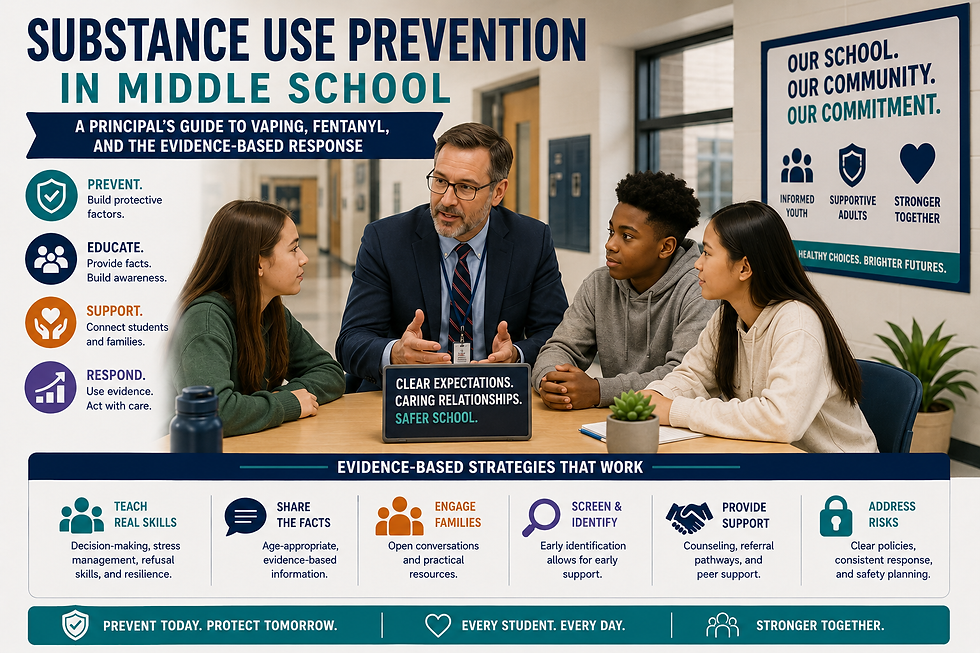
The Issue: A Substance Use Landscape That Has Fundamentally Changed
If you are a middle school principal in 2026, you are leading inside a substance use landscape that has changed more dramatically over the past five years than in any comparable period in recent history. The substances students are encountering, the routes of exposure, the level of lethality, and the public health response have all shifted in ways that make the prevention work middle schools were doing a decade ago genuinely obsolete.
The headline numbers deserve direct attention.
Adolescent overdose deaths. According to the American Academy of Pediatrics 2024 anticipatory guidance published in Pediatrics, "Drug overdoses and poisonings are now the third leading cause of death among American children and adolescents younger than age 19 years." In 2022, overdoses claimed the lives of more than 1,100 adolescents aged 14 to 18 — approximately the equivalent of a high school classroom every week. From 2019 to 2021, adolescent overdose mortality doubled, driven by the widespread infiltration of illicitly manufactured fentanyl into the U.S. drug supply. Fentanyl now causes more than three of every four adolescent overdose deaths.
The fentanyl problem at younger ages. The KFF October 2025 analysis of CDC data and the School Pulse Panel survey notes that while overall adolescent overdose death rates began to slow in 2023, they remain substantially higher than pre-pandemic rates. Black and Hispanic adolescents have experienced the fastest recent increases. The CDC data referenced in the 2024 New England Journal of Medicine article on the overdose crisis among U.S. adolescents documents that most adolescent overdoses occur in the home, that two-thirds of the time another person was present but unaware, and that naloxone — the easy-to-administer nasal spray that can reverse an overdose in minutes — was administered in only one of three deaths.
The counterfeit pill problem. Nearly a quarter of adolescent overdose deaths involve counterfeit pills laced with fentanyl that were not prescribed by a doctor. This is a categorically different exposure pattern than the substance use patterns most adults experienced in adolescence. A student today taking what they believe to be a Xanax or a Percocet purchased through social media may be taking a counterfeit pill containing a lethal dose of fentanyl. Awareness of this risk among middle schoolers and their families remains uneven.
Vaping persistence and intensification. The November 2025 JAMA Network Open study of nicotine vaping trends from 2020 to 2024 found that while overall vaping rates declined among adolescents, the share of current users who vape every day nearly doubled — from 15.4% to 28.8%. The percentage of daily vapers who unsuccessfully tried to quit rose from 28% to 53%. The pattern is concerning: fewer students are vaping, but the students who do are increasingly addicted. Notably, daily vaping in rural areas rose dramatically from 16% in 2020 to nearly 42% in 2024.
The middle school-specific vaping pattern. The FDA and CDC 2024 National Youth Tobacco Survey documented that current e-cigarette use among middle and high school students declined significantly between 2023 and 2024 — from 7.7% to 5.9%, or from 2.13 million to 1.63 million students. But analysis of the data shows that while high school use dropped from 10% in 2023 to 7.8% in 2024, middle school use showed no statistically significant change. Prevention efforts appear to be reaching older students more effectively while younger students remain at risk. Vaping typically begins in middle school and becomes entrenched by ninth and tenth grade.
Co-occurring substance use. CDC data shows that among middle school students who currently used a tobacco product in 2024, more than one in three (38.9%) used more than one type. Nearly one in three middle and high school students who had ever used an e-cigarette reported using marijuana in the device. Vaping, in many cases, is the gateway to broader substance experimentation — including, increasingly, exposure to substances that may contain fentanyl.
This is the substance use landscape middle school principals are leading inside of. It is more lethal, more deceptive, and more concentrated at younger ages than the landscape a generation ago. And the prevention practices most schools rely on were developed for a different problem.
This article is for middle school principals who want their prevention work to address the substance use crisis as it actually exists in 2026 — not as it existed in 2010.
Why Middle School Is the Critical Prevention Window
Middle school is the developmental and structural window where substance use prevention is most consequential. The reasons are converging from multiple research traditions.
The first-use window. Substance use that begins in middle school is substance use that has the longest trajectory in front of it and the most cognitive and emotional development still underway. The brain regions responsible for impulse control, risk evaluation, and emotional regulation are actively forming in early adolescence. Substances introduced during this window can shape neurodevelopment in ways that substances introduced later cannot.
The social initiation pattern. Research summarized in school vaping statistics shows that 60% of vapers got their first e-cigarette from a friend, and most tried vaping for the first time while "hanging out" with friends. Students describe vaping as "something to do with friends" and a social bonding activity. The same social-initiation pattern applies to most substance experimentation at this age. Prevention has to address the social context, not just the individual choice.
The mental health overlay. A growing body of research documents that adolescent substance use is increasingly intertwined with mental health symptoms. Many middle schoolers describe using nicotine or other substances specifically to manage anxiety, stress, or depression. This is a categorically different motivation than the recreational or peer-driven use that prevention programs were historically designed to address. Schools that treat substance use as separate from mental health miss a critical link.
The accessibility shift. Substances that previously required adult connections to obtain are now accessible to middle schoolers through social media, including through algorithmic discovery they did not seek. A twelve-year-old browsing social media can encounter substance content within minutes — including content from sellers who market counterfeit pills, vape devices, and other substances. The barrier between adolescent curiosity and substance access has substantially collapsed.
The information asymmetry problem. Many parents and families operating from their own adolescent experience underestimate the contemporary risks. The pill that was a low-stakes experiment in their adolescence may be a fentanyl-laced counterfeit today. Family-based prevention conversations grounded in outdated information can leave students less protected, not more.
This is the developmental and structural reality middle school substance use prevention has to address. The schools that succeed at it organize prevention around these realities. The schools that fail typically import prevention frameworks designed for a different era and find they no longer fit.
The Evidence: What Schools Are Actually Doing — and What Works
The most authoritative current data on what schools are doing comes from the federal School Pulse Panel and the KFF analysis published in October 2025.
Naloxone in schools. The KFF analysis found that 77% of public schools reported storing naloxone on campus during the 2024–2025 school year. Several states now mandate that schools stock naloxone, and many others recommend or allow it. The patterns are not uniform: schools with fewer students of color, in lower-poverty neighborhoods, at middle and high school levels (vs. elementary), and with 1,000+ students were more likely to store naloxone. Only 1% of public schools reported that naloxone was actually administered at school or a school event during 2024–2025 — meaning naloxone in schools functions overwhelmingly as a preventive readiness measure, not as a frequently-used intervention.
Staff training on overdose recognition. Nearly 3 in 4 public school administrators reported that some or all of their staff were trained to recognize a drug overdose: 30% reported that all teachers and staff are trained, 44% reported some, and 16% reported none. The most commonly trained staff are nurses, security personnel, and administrative staff.
Fentanyl education for students. Per the same KFF data, 52% of public schools reported offering fentanyl education to students in 2024–2025, using methods including classroom instruction (30%), school assemblies (22%), and events held for school families (22%). Half of all public schools — and the half most likely to be in higher-resource contexts — are doing this work. The other half is not.
Treatment access at schools. The KFF analysis notes that over 480,000 adolescents received substance use treatment at school in 2023, underscoring how schools can serve as access points for these services. Yet less than one-third of adolescents with a past-year opioid use disorder reported receiving any treatment.
School-based prevention program effectiveness. A July 2025 peer-reviewed evaluation published in PMC of a two-year school-based vaping prevention program — using a condensed version of the Stanford University Tobacco Prevention Toolkit — found that the program increased health literacy and that "higher baseline knowledge and those with greater increases in knowledge" were associated with reduced vaping initiation. The study's bottom line: "The findings support the effectiveness of school-based vaping prevention programs in increasing health literacy. The results underscore the importance of early prevention efforts of targeting middle school students before vaping behaviors become established."
The truth campaign evidence. The Truth Initiative research shows that young people with strong truth brand awareness and loyalty had significantly lower odds of vaping and intending to vape a year and a half later. Young people who had seen truth campaigns were more likely to believe e-cigarettes were harmful and socially unacceptable and to hold anti-tobacco-industry attitudes. The campaign effect is real and measurable.
What does not work. The evidence base on prevention is now strong enough to identify what does not work. Single-session assemblies, scare-tactic curricula, and stand-alone enforcement-based responses have repeatedly been shown to produce minimal or no behavioral effects. The evidence does not support these approaches, despite their continued popularity.
The cumulative picture is clear: school-based substance use prevention works when it is sustained, evidence-based, integrated with mental health support, and paired with credible health information delivered consistently — not as a one-time event but as ongoing health literacy work. School-level investments in naloxone readiness, staff training, fentanyl-specific education, and treatment access are demonstrably reaching schools but are reaching them unevenly.
The Federal and State Policy Context
Several policy developments over the past two years deserve direct attention from middle school principals.
The October 2023 letter from the U.S. Department of Education and the White House drug policy office formally encouraged schools to educate students about the opioid epidemic and to keep naloxone on hand. This federal guidance is now part of the policy landscape principals operate inside.
Multiple states have moved toward naloxone mandates or active distribution. The Washington State Department of Health is offering naloxone to all public high schools. Other states have similar programs at various levels of implementation.
The American Academy of Pediatrics 2024 anticipatory guidance on preventing adolescent overdoses provides the most authoritative clinical framework currently available. The framework includes: educating families about fentanyl and counterfeit pills, normalizing naloxone availability in homes with adolescents, treating substance use as a medical issue rather than primarily a disciplinary one, and connecting adolescents and families to treatment when use is identified.
The middle school principal operating in 2026 should be familiar with their state's specific naloxone policies, their district's substance use response framework, and the AAP clinical guidance. These three frameworks together define the policy environment within which prevention work has to operate.
The Structural Layer Most Prevention Programs Skip
Beyond formal curriculum and naloxone readiness, there is a structural reality that substance use prevention often does not address: the daily conditions of the school substantially affect both the supply environment for substances and the demand environment among students.
The bathroom problem. Educators consistently identify school bathrooms as hot spots for vaping activity. The structural design of the school day — including how bathroom passes are managed, how often bathrooms are checked, and how transitions are supervised — substantially affects bathroom-based substance use. Schools that have invested in bathroom monitoring, vape detection technology, and structured transition supervision report meaningful reductions in bathroom vaping.
The social media access problem. Many of the most concerning substance use exposure pathways for middle schoolers run through social media — both algorithmic discovery of substance content and direct communication with sellers. A middle school that allows unrestricted phone access during the school day is a middle school where these exposure pathways remain open during the seven-hour window the school could otherwise structurally close. Schools that have implemented decentralized phone-free school days — for example, the Safe Pouch system from Win Elements, in which every adult has unlocking authority — close the in-school exposure window structurally. The daily exposure to substance marketing, peer messaging about substances, and direct seller contact that would otherwise occur during instructional time is eliminated. This is not a substitute for substance use prevention curriculum. It is a structural condition that makes the curriculum's work more likely to take hold.
The mental health infrastructure problem. Many students who use substances are using them to manage mental health symptoms — anxiety, depression, sleep problems, trauma responses. Schools with strong mental health infrastructure can address the underlying need before substance use becomes the coping mechanism. Schools without it find that prevention curriculum, however well-designed, addresses the symptom rather than the cause.
The connection and belonging dimension. Research consistently identifies school connectedness, peer belonging, and trusted adult relationships as protective factors against adolescent substance use. Schools that invest in connectedness — through advisory programs, mentoring, sustained adult-student relationships — produce protective effects that complement formal prevention curriculum.
For additional research on how structural school conditions — including phone policy, school climate, and student-adult relationships — connect to adolescent health behavior, see the Win Elements research library.
The Practice: A Middle School Principal's Playbook for Real Substance Use Prevention
If you are a middle school principal trying to lead substance use prevention that addresses the 2026 reality, here is a research-based sequence drawn from the strongest current evidence.
Step 1: Get an honest read on what is happening in your school
Before designing any intervention, document what your school's substance use reality actually consists of. Sources of information:
Anonymous student survey data — the Youth Risk Behavior Survey, the Monitoring the Future survey, or comparable instruments give you trend data on actual use patterns.
Nurse and counselor observations about substance-related incidents and conversations.
Discipline data related to substance use, including bathroom vaping incidents.
Conversations with student leaders who can describe what is actually happening socially.
Family input through structured channels.
The honest assessment will likely surface uncomfortable findings: more use than visible to administration, more substances involved than expected, and more students affected as bystanders or family members than appears in formal data. That is the starting point for substantive prevention work.
Step 2: Stock naloxone and train staff to use it
Given the lethality of fentanyl-laced substances, stocking naloxone and training staff to recognize and respond to overdoses is a baseline readiness measure that every middle school should have in place. The KFF data shows 77% of schools nationally are doing this. If your school is in the 23% that is not, this is the most urgent step to take.
Concrete moves:
Stock naloxone in nurse offices and front offices, at minimum, and consider additional locations including counseling offices.
Train multiple staff members to recognize overdose symptoms and administer naloxone — nurses, administrators, counselors, security, and trained classroom teachers.
Develop a clear response protocol for suspected overdose, including immediate 911 contact even when naloxone is administered (naloxone can wear off after 30 to 90 minutes, allowing the original substance to reactivate).
Coordinate with local EMS so first responders know the school is naloxone-equipped and can integrate response accordingly.
Ensure familiarity with state law regarding naloxone administration in schools.
This is preparedness work. Most middle schools will never administer naloxone on campus. But the schools that need it desperately need it, and readiness is the lowest-cost, highest-protection investment available.
Step 3: Deliver evidence-based prevention curriculum at appropriate dosage
Prevention curriculum works when it is sustained, evidence-based, and developmentally appropriate. The Stanford Tobacco Prevention Toolkit is well-supported by recent evaluation. Multiple other evidence-supported curricula exist. The Cochrane Collaboration and the federal SAMHSA evidence-based practices registry provide authoritative reviews.
Effective implementation:
Multi-session curriculum rather than one-time assemblies.
Integration into health, science, or advisory blocks — not stand-alone events.
Trained instructors who can deliver the curriculum with fidelity.
Updated content that addresses fentanyl, counterfeit pills, vaping, and the actual substances students encounter.
Integration with mental health programming that addresses underlying coping needs.
Step 4: Address fentanyl specifically
The fentanyl-specific dimension deserves direct attention in middle school prevention. The lethality, the counterfeit pill problem, and the access patterns are categorically different from earlier substance use risks.
Fentanyl-specific education should cover:
The basic facts — what fentanyl is, why it is in the substance supply, how lethal it is.
The counterfeit pill problem — that pills purchased through social media or non-medical sources may contain lethal doses of fentanyl regardless of how they appear.
Recognition of overdose — what overdose looks like, what to do, how to call 911 without legal fear for the reporting student.
Naloxone — what it is, that the school has it, and that families can also obtain it.
Good Samaritan laws — most states have laws protecting individuals who call for help during an overdose. Students should know about them.
This is sensitive content. It should be delivered by trained instructors, supported by counseling availability, and structured to provide protective information without inducing curiosity or fear that could be counterproductive.
Step 5: Build family education and partnership
Families are essential partners in adolescent substance use prevention — and many families are operating from outdated information about the current substance landscape.
Effective family engagement includes:
Plain-language education on the current substance use reality, including fentanyl and counterfeit pills.
Practical guidance on how to talk with their middle schooler about substances without producing the backlash effect that scare tactics often produce.
Information on naloxone — including how families can obtain it for their own homes.
Resources for treatment access if family members suspect or know of use.
Non-stigmatizing communication — research consistently shows that stigmatizing language makes it less likely that students or families will seek help.
The most consequential moment in family substance use education is often when a family does not yet know they need it. Schools that build family knowledge proactively are schools where families can respond effectively when something is happening at home.
Step 6: Build the structural conditions that reduce exposure
Prevention curriculum works better in schools where the structural conditions reduce daily exposure to substance use cues and content.
Concrete moves:
A genuinely enforced phone-free school day that closes the in-school window for social media-mediated substance exposure, peer pressure, and seller contact during the seven hours students spend at school.
Bathroom monitoring and supervision practices that reduce bathroom-based vaping without becoming surveillance-state in tone.
Strong adult presence in unstructured spaces.
School climate work that builds connection, belonging, and trust between students and adults.
These structural conditions are not substitutes for curriculum or family partnership. They are conditions that make curriculum and partnership more effective.
Step 7: Connect students who are using to treatment, not just discipline
A consistent failure mode in school substance use response is the over-reliance on disciplinary consequences for students who are detected using substances. The disciplinary response, especially when applied without coordinated treatment access, often pushes the student away from adult support and into deeper substance involvement.
The American Academy of Pediatrics anticipatory guidance and emerging best practice frameworks emphasize that substance use among adolescents is a clinical issue that requires medical and behavioral health response — not primarily a disciplinary issue.
Practical moves:
Trained school counselors and social workers who can do initial substance use assessment and brief intervention.
Partnerships with adolescent treatment providers who can absorb referrals.
Clear pathways that connect students and families with treatment, with as little stigma and friction as possible.
Coordinated response that involves discipline appropriate to the school context while also opening clinical and family support.
Continued school enrollment as the default for students engaged in treatment, not removal as the default.
Step 8: Address the equity dimensions
Substance use, overdose deaths, and treatment access are all marked by significant inequities. The recent acceleration of overdose deaths among Black and Hispanic adolescents is one of the most concerning trends in the current data. Naloxone is less likely to be available in schools serving students of color. Treatment access is uneven.
Addressing these inequities includes:
Ensuring that prevention curriculum reaches all students, not concentrated in particular tracks or programs.
Disaggregating school substance use data by demographic groups when possible.
Building family partnerships that span linguistic and cultural diversity.
Connecting families to treatment resources that are accessible across income and insurance status.
Step 9: Coordinate with district and community resources
Substance use prevention is not work a single middle school can do alone. The district's broader prevention infrastructure, local public health agencies, adolescent treatment providers, and community-based organizations are partners in the work.
Building these partnerships includes:
District-level coordination that aligns prevention curriculum and response protocols across schools.
Local public health partnership for naloxone access, training, and community campaigns.
Adolescent treatment provider relationships that enable referral and warm handoff.
Community-based organization partnerships for family support and peer-based prevention work.
What the Research Still Doesn't Tell Us
Honest leadership requires acknowledging the limits of current evidence.
What works at scale to reduce middle school vaping initiation? The research supports school-based programs in principle but the field is still developing the most effective implementation models.
What is the optimal age and dosage for fentanyl-specific education? Curriculum is being developed and evaluated, but rigorous outcome research is limited.
How can prevention curriculum address the mental health-substance use connection most effectively? This is one of the most important emerging questions in the field and one where existing curriculum is still adapting.
How will the substance use landscape continue to evolve? New substances, new delivery mechanisms, and new social media-mediated access patterns continue to emerge faster than prevention practices can be evaluated.
The Bottom Line for Middle School Principals
The substance use prevention work that middle schools are doing in 2026 is operating inside a categorically different threat environment than the work of a decade ago. Fentanyl has made occasional experimentation potentially lethal. Vaping has produced a generation of adolescents with nicotine addiction patterns that are difficult to reverse. Social media has collapsed the access barriers that previously protected younger adolescents. And the prevention frameworks most schools rely on were not designed for these realities.
The leadership commitment is to update the work — substantively, evidence-based, and at the dosage the framework requires. Stocking naloxone. Training staff. Delivering sustained, evidence-based curriculum. Educating families on the actual current risks. Closing the structural windows that enable in-school exposure. Connecting students who are using to treatment rather than only to discipline. Addressing the equity dimensions of access and response. Coordinating with district and community resources.
None of this work is the work of a single year or a single program. It is sustained leadership infrastructure that takes shape over years.
The students at your school are operating in a substance environment that is more dangerous than the environment their parents navigated. The work you lead — in curriculum, in readiness, in family partnership, in structural school conditions, in treatment access — is among the most consequential health work your school does. Some of it is uncomfortable to discuss. All of it is necessary.
Lead the work as health work, not as compliance. The lives of your students depend, in some real and irreducible ways, on the difference.
Sources Cited
Friedman J, Hadland SE. "The Overdose Crisis among U.S. Adolescents." New England Journal of Medicine, 2024. PMC.
Hadland SE, et al. "Anticipatory Guidance to Prevent Adolescent Overdoses." Pediatrics, American Academy of Pediatrics, May 2024.
KFF. "How Schools Have Responded to the Youth Fentanyl Crisis." October 2025.
USC Keck School of Medicine. "Among youth who vape, USC study finds rise in daily use and difficulty quitting." Coverage of November 2025 JAMA Network Open study.
U.S. FDA. "Results from the Annual National Youth Tobacco Survey (NYTS)." 2024.
Get Safe and Sound. "School Vaping Statistics, Data & Trends (2026)." December 2025.
Powers Health. "Teen Nicotine Vaping Trends Show Powerful Evidence Of Addiction." Coverage of November 2025 JAMA Network Open study.
Truth Initiative. "E-cigarettes: facts, stats and regulations."
Montgomery County Public Schools. "Preventing Substance Use and Opioid Overdoses in Youth."


Comments