

Phone-Free High Schools: A Principal's Guide to Leading the Transition From Policy to Real Enforcement in Grades 9–12
- John Nguyen
- 11 hours ago
- 16 min read
Why high schools are the hardest setting for phone-free implementation, what the October 2025 causal evidence actually shows, and how to lead a policy that produces measurable outcomes rather than constant compliance friction

The Issue: A Policy Wave That High Schools Have Largely Watched Pass By
If you are a high school principal in 2026, you are leading inside one of the most rapidly shifting policy environments in American K–12 education — and your school is statistically the least likely segment of the K–12 system to have implemented the policy at the level the research now supports.
The pattern is documented. According to February 2025 data from the National Center for Education Statistics School Pulse Panel, 77 percent of public schools prohibit students from using cell phones during any class. But the figure varies dramatically by grade band: 86 percent of elementary schools have such policies, compared to only 55 percent of high schools. High school is the level where phone-free policy adoption lags most significantly — and where the policies that exist tend to be the most diluted, most exception-laden, and most inconsistently enforced.
At the same time, the state-level policy environment has shifted with unusual speed. As of late 2025, at least 35 states have passed bills restricting cell phone use in schools. Other tracking sources put the figure at 31 states plus the District of Columbia as of October 2025 requiring districts to limit or ban cell phone use in K–12 classrooms, with most of these actions occurring in 2025. The legal and policy environment that high school principals are operating inside of has changed substantially in the past 18 months — and continues to change.
And in October 2025, the strongest causal evidence to date on cell phone bans was published. The NBER Working Paper "The Impact of Cellphone Bans in Schools on Student Outcomes: Evidence from Florida", by David Figlio and Umut Özek, examined the causal effects of phone bans on student test scores, suspensions, and absences using detailed student-level data from Florida and a quasi-experimental research strategy. The findings, summarized in the November 2025 EdWorkingPapers Policy & Practice Series brief, provide the clearest evidence yet on what phone-free policies actually produce when implemented well — and what they require from principals to produce those outcomes.
This article is for high school principals navigating this policy environment substantively. Phone-free policies in high schools are operationally harder than in middle schools or elementary schools — and the research base now supports them more strongly than it did even a year ago. The leadership work is to translate that policy framework into actual school-level implementation that produces the measurable outcomes the evidence describes.
Why High School Is the Hardest Setting for Phone-Free Implementation
Within K–12, high schools sit at the hardest point in the phone-free policy implementation curve. The reasons are structural and worth naming directly before turning to the evidence and the practice.
The autonomy expectation gap. High school students, particularly upperclassmen, have spent years operating with increasing autonomy and personal responsibility. A phone restriction policy can feel — to students, families, and even some staff — like a reversion to middle school norms. The legitimacy challenge is substantial. Policies imposed without adequate community engagement produce predictable resistance from students who interpret the change as paternalistic.
The transportation and after-school coordination problem. High school students drive themselves to school, coordinate after-school work schedules, manage athletic and extracurricular logistics, and participate in dual-enrollment college coursework. The genuine logistical role phones play in high school student life is meaningfully different from the elementary or middle school case. Phone-free policies that ignore this logistical reality face higher legitimate friction than policies that address it head-on.
The family communication expectation. High school families have grown accustomed to direct, real-time communication with their adolescents during the school day. Many families have explicitly relied on this communication channel — and have not been prepared for its structural removal. The October 2025 Florida research notes that the most consistent friction in implementation comes from parent communication expectations, not student behavior.
The size and scale problem. A typical high school is substantially larger than a typical middle school or elementary school. Enforcement at scale — across 1,500, 2,000, or 3,000 students, across dozens of teachers, across hundreds of class transitions per day — is operationally harder than enforcement in smaller settings. The per-classroom-teacher enforcement model that survives at smaller schools collapses at high school scale.
The disciplinary equity dimension. This deserves particular attention. The October 2025 NBER study found that the enforcement of cellphone bans in schools led to a significant increase in student suspensions in the short-term, especially among Black students — though disciplinary actions began to dissipate after the first year. The implication is critical: phone-free policies implemented in high schools without thoughtful enforcement design can compound existing disciplinary disparities. The implementation choices matter enormously for equity outcomes.
The grade-level adoption pattern. Younger students — and the teachers of younger students — have generally adapted to phone-free environments more readily than older students. The behavioral muscle for sustained attention without device access has eroded most substantially among high schoolers, who have lived their entire adolescence with smartphone access. The cognitive and behavioral demands of adjusting to phone-free environments are objectively higher for high schoolers than for younger students.
This is the structural reality high school principals are leading inside of. And it is the reason policies designed for elementary or middle school contexts often fail when transferred directly to high schools without adaptation.
The Evidence: What the October 2025 Research Actually Shows
The publication of the Figlio and Özek NBER working paper in October 2025 substantially changed the evidence landscape on school cell phone policies in the United States. Before this paper, the U.S. evidence base was characterized by the Fordham Institute as "policymaking by vibe" — driven by intuition and anecdote rather than rigorous causal research. The Florida study is the strongest causal evidence to date on what phone-free policies actually produce in U.S. high schools.
The methodology matters. The researchers used detailed student-level data from a large Florida urban district and applied a quasi-experimental design that relied on differences in pre-ban cell phone use by students, as measured by building-level Advan data. This is not a correlational comparison of schools that adopted policies versus schools that did not. It is an attempt to isolate the causal effect of the policy by comparing student outcomes within schools and over time.
The findings deserve direct attention from high school principals.
Finding 1: Short-term disciplinary spike, then adjustment. The NBER paper found that enforcement of cellphone bans led to a significant increase in student suspensions in the short term, especially among Black students. This is the disciplinary equity finding noted above. Critically, the disciplinary actions began to dissipate after the first year, "potentially suggesting a new steady state after an initial adjustment period." The implication is that the first year of implementation is the hardest — and that principals planning multi-year implementation should anticipate and budget for short-term disciplinary friction.
Finding 2: Improved attendance over time. The EdWorkingPapers Policy & Practice Brief summarizes the longer-term findings: over time, the policy was associated with improved attendance and improved test scores, suggesting that reducing distractions can enhance student focus and academic performance. The attendance improvement is striking and somewhat counterintuitive — one might expect students to skip school more if they cannot use phones during the day. The opposite occurred.
The Fordham Institute analysis of the same research offers a plausible mechanism: "Fear of missing out when friends are engaging in person at school. Others told me with confidence that the inability to quickly text home for a pick-up without trekking to the main office to call via landline under the glaring eyes of the office staff contributes to more kids spending their school day in the classroom." The structural absence of the easy parent-coordinated early departure may be part of what improves attendance.
Finding 3: Improved test scores over time. Two years after the imposition of a student cell phone ban, student test scores in a large urban school district were significantly higher than they would have been without the policy. This is the academic outcome finding that prior U.S. research had not been able to establish with causal rigor.
Finding 4: Implementation strength matters. The Figlio and Özek findings are strongest in the school district that "went further" than the state's minimum requirement — requiring devices to be silenced and stored away during the entire school day, not just during instructional time. The implementation strength dimension is consistent with the broader policy evidence: "bell-to-bell" implementation produces meaningfully different outcomes than instructional-time-only restriction.
The international evidence triangulation. The UK SMART Schools study, published in The Lancet Regional Health - Europe, examined the impact of UK restrictive school phone policies on health and educational outcomes among 1,227 adolescents aged 12–15 in 30 schools. The international evidence triangulates the U.S. findings: phone restriction is associated with measurable improvements in attention, peer interaction, and educational engagement when implemented at adequate dosage.
The teacher and educator evidence. A January 2026 Paragon Institute review of the literature found that in a southeastern Virginia school division surveyed in April 2025, 78 percent of teachers supported the state's newly implemented K–12 cell phone ban, with 62 percent reporting improved student behavior. In focus groups, teachers described increased student engagement and stronger peer interaction due to reduced phone distractions. Among public high school teachers nationally, 72 percent say cell phones are a major classroom problem, and 83 percent of educators support all-day restrictions with limited exceptions.
The cumulative picture is unusually clear by social science standards. Phone-free policies, when implemented at sufficient strength (bell-to-bell rather than instructional time only), produce measurable improvements in attendance, test scores, classroom behavior, and student engagement. The implementation requires anticipating short-term disciplinary friction and family communication adjustment. The evidence base is now strong enough that the question for high school principals is not whether to implement, but how.
The Implementation Strength Distinction That Drives Outcomes
A critical insight from the recent evidence — one that high school principals planning implementation should internalize directly — is that not all phone-free policies produce the same outcomes. The strength of the policy substantially determines its effects.
The Phone-Free Schools State Report Card — the first comprehensive assessment of state-level phone-free legislation against an evidence-based gold standard — makes this point explicit: "The period of time during which personal electronic devices are prohibited, combined with how those devices are stored, is the strongest predictor of a successful policy. Evidence supports that the stricter the school cell phone policy" — bell-to-bell rather than instructional-time-only, structural storage rather than student self-management, full school day rather than just classroom time — the stronger the outcomes.
The implementation strength dimensions worth naming:
Time window. Bell-to-bell restriction (the entire school day including passing periods, lunch, and breaks) produces meaningfully different outcomes than instructional-time-only restriction (only during class). Students who can access phones between classes do not develop the sustained attention pattern that drives the documented academic improvements. They also continue to engage in the social media-driven dynamics that drive much of the negative behavioral and mental health effects.
Storage method. Policies that require structural storage of devices — in lockers, in pouches, in classroom holders — produce different outcomes than policies that allow students to keep silenced devices in their pockets or bags. The "out of sight, out of mind" effect is real and documented. Phones that remain accessible continue to capture attention even when not actively used.
Enforcement architecture. Policies that depend on each individual teacher enforcing phone restrictions in their classroom produce different outcomes than policies that build enforcement into the school structure. Per-teacher enforcement creates a continuous policing demand on teachers, generates inconsistency across classrooms, and burns out the teachers most committed to the policy. Structural enforcement, where the phone is genuinely inaccessible during the school day, eliminates the per-classroom enforcement burden.
Exceptions and accommodations. Policies with extensive exceptions — medical, IEP, family communication, work coordination, etc. — produce different outcomes than policies with narrow, carefully defined exceptions. Each exception creates an implementation gap. Schools that have effectively eliminated most exceptions (with a small set of legally-required accommodations for documented medical needs and IEPs) report substantially stronger outcomes than schools that have allowed exceptions to multiply.
The high school principal designing or strengthening a phone-free policy should be conscious of these dimensions. The policy strength choices determine the outcome strength.
The Operational Layer: Why Decentralized Enforcement Matters at High School Scale
The enforcement architecture dimension deserves particular attention at high school scale. The per-classroom-teacher enforcement model that survives in smaller schools collapses at high school scale for a documented set of reasons.
The teacher load problem. A high school teacher who teaches five classes per day across 150 students cannot effectively monitor phone compliance across that volume while also delivering instruction. The teacher who tries becomes the de facto disciplinarian for every class period, generates resentment from students for whom the phone confiscation is the primary daily school experience, and burns out under the cumulative stress. The teachers most committed to the policy disproportionately bear the enforcement cost.
The inconsistency problem. Across 80 to 100 teachers in a typical high school, no two will enforce the same policy identically. Some will be strict, some lenient, some inconsistent across different days. Students notice these variations and route their phone use to the classrooms where enforcement is weakest. The schoolwide policy becomes, in practice, a patchwork of classroom-level policies — which is to say, not really a policy at all.
The bottleneck problem. Centralized enforcement — where students who violate the policy are sent to an administrator, who confiscates the phone and returns it at end of day — creates an administrative bottleneck that becomes unsustainable at high school scale. A school with 50 daily phone violations cannot route all of them to a single administrator without grinding administrative capacity to a halt.
The structural alternative. Schools that have successfully implemented phone-free policies at high school scale have generally moved toward what might be called decentralized structural enforcement — where the phone is genuinely inaccessible during the school day through a structural mechanism (a magnet-locked pouch, a locker, a classroom storage system), and where multiple adults in the building have the capacity to handle exceptions and unlocking. The structural mechanism removes the device from accessibility; the decentralized unlocking authority handles the legitimate exceptions without bottleneck.
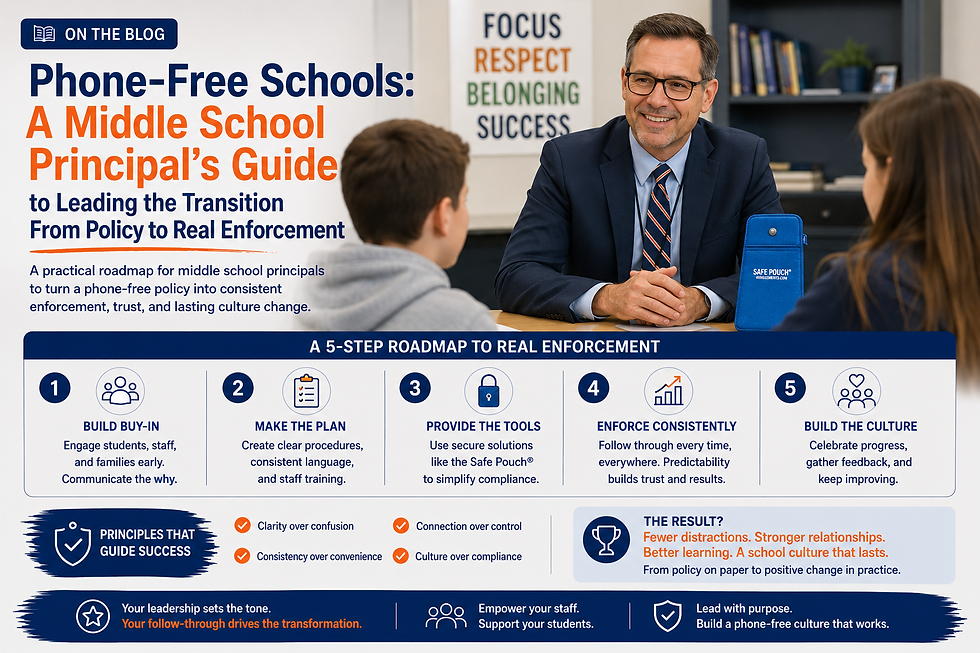
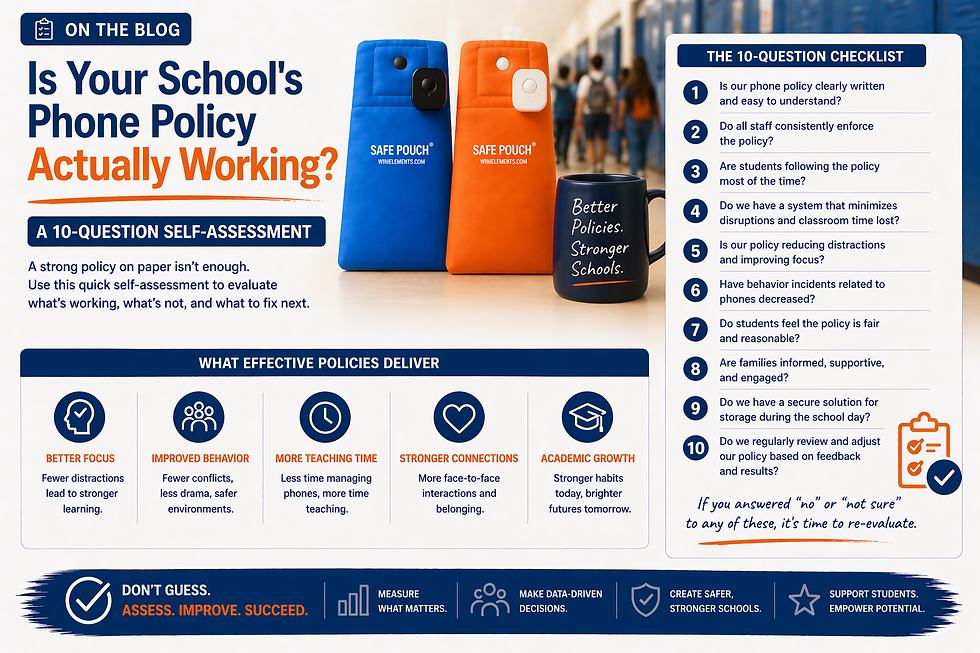
This is the operational architecture that distinguishes high school phone-free implementations that work at scale from those that collapse under their own enforcement burden. Systems like the Safe Pouch system from Win Elements — which combines a magnet-locked pouch with decentralized unlocking authority distributed across every teacher and administrator in the building — are explicitly designed for the high school scale enforcement challenge. The pouch keeps the device structurally inaccessible during the school day. The distributed unlocking authority means no single administrator becomes the bottleneck for legitimate exceptions.
The structural enforcement architecture is not the policy itself. It is the operational layer that allows the policy to function at high school scale without breaking the people responsible for enforcing it.
For additional research on how structural school conditions — including phone policy, school climate, and student engagement — connect to academic outcomes and disciplinary patterns, see the Win Elements research library.
The Practice: A High School Principal's Playbook for Real Phone-Free Implementation
If you are a high school principal designing, launching, or strengthening a phone-free policy in 2026, here is a sequence drawn from the strongest current evidence.
Step 1: Know your state and district policy environment in detail
Before designing anything, document the specific legal and policy framework you operate inside. The 35 states with phone restriction legislation as of late 2025 vary substantially in what they require. Some mandate bell-to-bell. Some require only instructional-time restriction. Some specify storage methods; others leave implementation to districts. Some include emergency communication carve-outs; others do not.
The honest assessment of your specific policy floor is the starting point. Many high school principals are operating under state mandates more permissive than the evidence supports — which means the substantive implementation work is to go beyond the minimum, not to limit yourself to it.
Step 2: Build community engagement before launch — not after
The most consistent implementation failure pattern in high school phone-free policies is launching without adequate community engagement, then absorbing the backlash for months afterward. The legitimate concerns of families, students, and staff are worth engaging substantively before policy launch — not dismissing as resistance to change.
Substantive engagement includes:
Public communication of the evidence base — including the October 2025 Florida findings and what they actually show.
Explicit response to family communication concerns — how families can reach their student in emergencies, how students can coordinate work and after-school logistics, how the school handles legitimate accommodations.
Student voice — not as a veto, but as substantive input on how the policy is designed and rolled out.
Teacher engagement — particularly on enforcement architecture, since teachers carry the implementation burden under most designs.
Honest acknowledgment of trade-offs — phones do play legitimate roles in some high school student lives, and the policy is making a deliberate choice that the academic and developmental benefits outweigh those costs.
The schools that engage well before launch absorb less backlash after. The schools that skip this step generally pay for it for the entire first year.
Step 3: Choose the implementation strength deliberately
Given the evidence on implementation strength, the high school principal designing a policy should make conscious choices on each dimension:
Time window: Bell-to-bell or instructional-time-only?
Storage method: Structural storage or student self-management?
Enforcement architecture: Per-teacher or decentralized structural?
Exceptions: Narrow and defined or broad and permissive?
The evidence supports the stronger choice on each dimension. The principal making the weaker choice on each dimension should do so consciously, knowing they are accepting weaker outcomes — not by default, but as a deliberate decision based on local context.
Step 4: Design family communication infrastructure deliberately
The most legitimate concern families raise about phone-free policies is the loss of direct, real-time communication with their student during the school day. The schools that handle this concern well do so structurally:
Clear emergency communication channels through the main office, with explicit response time commitments.
Routine non-emergency communication channels that allow families to leave messages for students that are delivered in defined windows.
Family education on the new communication norms, including how the school will reach them and how they can reach their student.
Honest acknowledgment that the policy represents a deliberate cultural shift back to pre-smartphone norms, and that the shift includes some genuine costs that the school believes are outweighed by the benefits.
The schools that fail to design this infrastructure absorb continuous family friction. The schools that design it well find that family concerns settle within the first semester.
Step 5: Anticipate and manage the disciplinary spike
The October 2025 NBER finding on short-term disciplinary spike — especially for Black students — is the most important equity dimension of phone-free implementation. Schools that do not anticipate this risk compounding existing disciplinary disparities. Schools that do anticipate it can design implementation to minimize the disparity.
Concrete moves:
Restorative response as the default for first and second policy violations, rather than immediate exclusionary discipline.
Equity audit of enforcement — tracking which students are being cited, by which staff, in which classrooms, and addressing patterns of disparate enforcement.
Staff training specifically on consistent enforcement and bias awareness.
Multi-year commitment — knowing that the disciplinary friction dissipates after the first year, and avoiding policy abandonment during the hardest implementation window.
Step 6: Build the enforcement architecture for sustainability
At high school scale, the per-classroom-teacher enforcement model is generally not sustainable. The schools that succeed long-term have generally moved to structural enforcement architectures.
The Safe Pouch system from Win Elements is one example of structural decentralized enforcement designed specifically for high school scale: the magnet-locked pouch makes the device structurally inaccessible during the school day, and the decentralized unlocking capacity distributed across every adult in the building handles legitimate exceptions without administrative bottleneck. Other structural enforcement approaches exist; the specific system matters less than the architectural choice to make enforcement structural rather than per-teacher.
The principal designing implementation should consciously choose the enforcement architecture before launch — not retrofit it after the per-teacher model has burned out the most committed teachers.
Step 7: Track outcomes that matter
The evidence supports phone-free policies producing improvements in attendance, test scores, classroom behavior, and student engagement. Track these. Document them. Use them to inform community communication and ongoing policy refinement.
Concrete outcome tracking includes:
Attendance data disaggregated by grade and demographic group.
Discipline data disaggregated by grade and demographic group, with particular attention to the equity dimension.
Academic performance indicators — course completion, grades, standardized assessment.
Climate survey data from students, teachers, and families.
Implementation fidelity data — actual compliance rates, exception volume, enforcement consistency.
The outcomes data is what allows the principal to defend the policy substantively when challenged and to refine implementation based on what is actually working.
Step 8: Sustain the work across multiple years
The Florida evidence makes clear that phone-free policies produce their strongest measurable outcomes over multiple years, not in the first semester. The schools that abandon the work during the difficult first year never see the outcomes the evidence describes. The schools that sustain it across two, three, and four years see the cumulative academic, behavioral, and cultural improvements.
This is fundamentally a leadership commitment. The principal who treats phone-free policy as a one-year initiative will not see the outcomes. The principal who treats it as multi-year structural reform — comparable to a serious MTSS implementation or a serious discipline reform effort — will.
What the Research Still Doesn't Tell Us
Honest leadership requires acknowledging the limits of current evidence.
How do outcomes vary across high school subpopulations? The Florida research is improving the U.S. evidence base, but disaggregated findings for English learners, students with disabilities, and other subgroups remain limited.
What is the optimal exception framework? The research supports narrow exceptions, but the specific design of medical, IEP, and family communication accommodations is still being refined.
How does phone-free policy interact with other school reform efforts? Schools rarely implement phone-free policy in isolation, and the interaction effects with MTSS, discipline reform, and instructional improvement are not well-studied.
What is the longest-term effect on student development? The evidence base is still measuring outcomes at one-to-three-year windows. The longer-term effects on adolescent development, academic identity, and post-secondary readiness are still emerging.
The Bottom Line for High School Principals
The phone-free policy conversation has changed substantially in the past 18 months. The state-level legislative environment has accelerated. The causal evidence base — particularly the October 2025 NBER study — has strengthened in ways that prior U.S. research had not been able to establish. The implementation insights from the research are clearer than they were a year ago. And the operational architectures designed for high school scale have matured.
The question for high school principals is no longer whether the evidence supports phone-free policy. It does, and more strongly than at any prior point. The question is implementation — at what strength, with what architecture, with what community engagement, with what attention to equity, sustained over what time horizon.
The students at your school will spend roughly 1,300 hours per year in your building. The structural conditions of those hours — including the cognitive conditions for sustained attention, the social conditions for peer interaction, and the behavioral conditions for academic engagement — substantially shape their high school experience and the trajectories that experience produces. Phone-free policy is one of the most significant structural decisions a high school principal can make.
The evidence supports the work. The students need the structural protection. The implementation challenge is real but well-mapped. Lead the implementation deliberately. The outcomes — for your students, your teachers, and your school culture — depend on it.
Comments